https://en.wikipedia.org/wiki/How_to_Read_Donald_Duck
1971 book-length essay by Ariel Dorfman and Armand Mattelart that critiques Disney comics from a Marxist point of view as capitalist propaganda for American corporate and cultural imperialism. It was first published in Chile in 1971, became a bestseller throughout Latin America and is still considered a seminal work in cultural studies. It was reissued in August 2018 to a general audience in the United States
The book’s thesis is that Disney comics are not only a reflection of the prevailing ideology at the time (capitalism), but that the comics’ authors are also aware of this, and are active agents in spreading the ideology. To that end, Disney comics use images of the everyday world:
“Here lies Disney’s inventive (product of his era), rejecting the crude and explicit scheme of adventure strips, that came up at the same time. The ideological background is without any doubt the same: but Disney, not showing any open repressive force, is much more dangerous. The division between Bruce Wayne and Batman is the projection of fantasy outside the ordinary world to save it. Disney colonizes the everyday world, at hand of ordinary man and his common problems, with the analgesic of a child’s imagination.”
— Ariel Dorfman and Armand Mattelart, How to Read Donald Duck, p. 148
This closeness to everyday life is so only in appearance, because the world shown in the comics, according to the thesis, is based on ideological concepts, resulting in a set of natural rules that lead to the acceptance of particular ideas about capital, the developed countries’ relationship with the Third World, gender roles, etc.
As an example, the book considers the lack of descendants of the characters. Everybody has an uncle or nephew, everybody is a cousin of someone, but nobody has fathers or sons. This non-parental reality creates horizontal levels in society, where there is no hierarchic order, except the one given by the amount of money and wealth possessed by each, and where there is almost no solidarity among those of the same level, creating a situation where the only thing left is crude competition.
duck funny
Just the bottom half of the comic goes even harder
Donald Soprano
I have trouble reading the donald speech bubbles they sound all quacky in my head.
Peak Disney
I mean Goofy did pretty much ask for it by saying “let 'er go”. I’m not really sure how else Donald should have interpreted that.
Old school Disney characters were downright psychopaths. Mickey was straight up waving his gun around on a regular basis.
Don’t forget Pooh!

Okay, fine, it’s just a pop gun. But I don’t think it ever appeared again, so I think it counts.
W-when you say gun…
Don’t worry–I’m talking about good ol’ wholesome firearms:
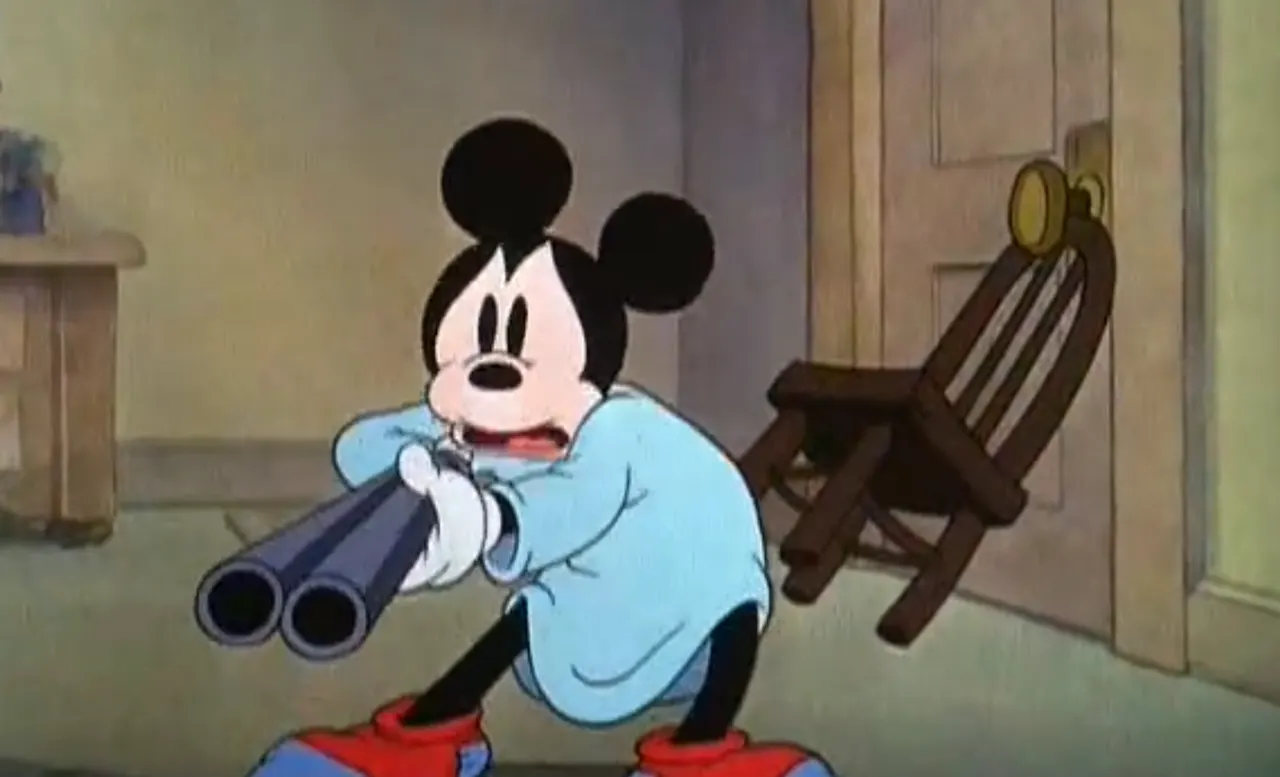
“Some firearms are so iconic, they don’t even need a name. No maker, no model, all you need to make an impression is a twin 12-gauge.”
- Ahoy, Iconic Arms - Double Barrel Shotgun
Read it in his voice, fucking fantastic channel.
Ah, to have a friend like Donald. Wish someone would do that to me.
https://www.youtube.com/shorts/4yU8PD-3kd0
Goofy was based on minstrel characters.
garsh
WHAT THE ABSOLUTE FUCK IS GOING ON WITH HER FILTER?!
And more importantly: HOW DID SHE NOT NOTICE BEFORE POSTING AND DO SOMETHING ABOUT IT?!"
Could be youtube optimization that borks. They compress the shorts pretty heavily.
Decaf is always an option.
HUH, so there IS a reason why Donald refuse to heal.
Fun fact, you can adjust his AI to make him much more likely to heal you in the pause menu.
I am thoroughly confuse right now. Did thy make an ai model out of donald duck or what?
Kingdom Hearts. Donald and Goofy are your main allies, with Donald serving as a wizard and Goofy as a knight. You’ll have other Disney and Square guest members of the party when you’re in their worlds (e.g. Jack Skellington can fight alongside you in Halloween Town and Simba will join you in the Pridelands), but Donald and Goofy travel with you between worlds and can pretty much always be selected for the party.
You can adjust Donald’s game AI to use more or less magic and items, and whether to prioritize things like healing or attacking.

Mfw people don’t know what game ai is anymore.
We live in an interesting time where people can not know what game AI is yet or anymore, as well as they should know it but don’t connect the dots because the term is overloaded.
I’m assuming Kingdom Hearts. I have no idea which one though. This might be an option in all of them, or maybe just some.
Yup. I know it’s an option in KH1, haven’t tried it in the others.
Key words: “pause menu”
Most cartoons were originally for adults. Helping your average schmuck, reading the daily paper, deal with feelings of societal injustice, anger, annoyance, frustration.
I seem to remember that DD used to be particularly vicious and rude in old b/w cartoons.
Is it possible that some duck creature already existed in Disney cartoons long before 1934?
How did (Disney) cartoons become a thing for kids mostly? When did kids become main targets for product development? I suspect the answer involves Edward Bernays…
I don’t think Donald’s schtick was so much rudeness/viciousness as it was that he had no control over his temper and had horrible luck. I remember cartoons opening with him being perfectly pleasant but then getting more and more unhinged as the cartoon goes on and things go wrong for him. To the point of homocidal destruction of everything around him.
He was a character that earned what happened to him after it happened, in his response to it.
Though this was also in a world where a lot of cartoons were casually extremely violent. Like Elmer Fudd was constantly trying to kill Bugs and Daffy, who each tried to get him to target the other or tried to get him, and then they’d casually discuss it at various points during the show. Mickey and Pete had a similar at times homicidal relationship, though Disney seemed to have more “I’m so angry I could kill you” while Looney Tunes had more “Trying to kill you is just what I do”.
DD also canonically has PTSD from the war. So there’s a lot going on there.
Thanks for the share! Didn’t know who Edward Nernays was until today. Super interesting (also not great).
Recommend: The Century of the Self
Apparently Sigmund Freud was his double uncle
Most of these comics are from the newspaper funny pages of the 1930’s. They had to apply to a broad audience of readers. Something for the adults and the kids. Just no one has to worry about Karen’s or if things were appropriate or not.
Hook, line and SUCCOR LMAO
I mean, if you have the ability, while drowning, to tie a rope around your own foot… you kinda deserve what’s coming
Yeah, let’s fatally punish people for mastering difficult tasks!
You’d be great as a talent show judge 😄
The point they’re making is that if he was really drowning, he would not have been able to tie a rope around his foot.
If he was really drowning, he also wouldn’t be an anthropomorphized dog in a comic strip, so I struggle to see your point
Might have just stood on the bottom with the other foot while tying it before returning to the flailing for his life.
gooby pls