I have been saying it for years, English is a very informal and open language, have fun with it. Sky water is not technically a wrong way to refer to rain, liquid laundry soup is absolutely a sauce for your laundry, dish bricks, day star, the list goes on
I remember an interview with Lisa Kudrow in which she described her French boyfriend’s failure to remember the English word for toes, and said they were foot fingers.
English: if the people you’re talking to understand what you’re saying, you’re ok. Even if the people you’re talking to don’t understand what you’re saying, you’re still ok. Just be fancy with your words, and everyone will like it.
I think this is one of the reasons why English (or it’s descendants) will forever be the international language of trade. If it’s not your first language, it’s damn difficult to make yourself sound like a native speaker, but it’s damn easy to make yourself understood.
On the flip side, a lot of other languages have retained structures which require a detailed knowing of grammar in part because they haven’t needed to be learned by amateurs.
Whereas English has adopted so many idioms from other languages with different grammar that we’re entirely comfortable with the exotic phrasing, or if it’s ambiguous we make puns and/or poetry from it.
True, though I would personally count that as a bad thing. Purity of language, to me is irrelevant. That opinion may be coloured by the fact that I’m a native English speaker, and there hasn’t been anything resembling purity in this language for thousands of years. To me, the point of language is open communication. Any impediment to that is a negative.

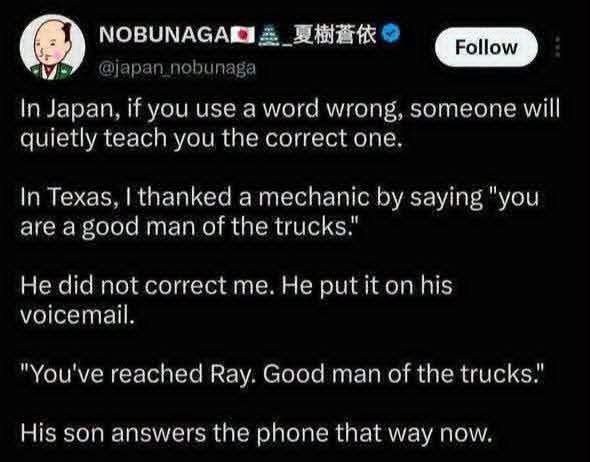
I have been saying it for years, English is a very informal and open language, have fun with it. Sky water is not technically a wrong way to refer to rain, liquid laundry soup is absolutely a sauce for your laundry, dish bricks, day star, the list goes on
I remember an interview with Lisa Kudrow in which she described her French boyfriend’s failure to remember the English word for toes, and said they were foot fingers.
English: if the people you’re talking to understand what you’re saying, you’re ok. Even if the people you’re talking to don’t understand what you’re saying, you’re still ok. Just be fancy with your words, and everyone will like it.
In french, that’s really the name that is given to them, colloquially : doigts de pied (foot fingers)
The real term is orteils (toes)
I knew someone who used the term “bird leaves” which I find hilarious.
I think this is one of the reasons why English (or it’s descendants) will forever be the international language of trade. If it’s not your first language, it’s damn difficult to make yourself sound like a native speaker, but it’s damn easy to make yourself understood.
On the flip side, a lot of other languages have retained structures which require a detailed knowing of grammar in part because they haven’t needed to be learned by amateurs.
Mate we’re all amateurs here. Unless you are being paid to learn languages
Whereas English has adopted so many idioms from other languages with different grammar that we’re entirely comfortable with the exotic phrasing, or if it’s ambiguous we make puns and/or poetry from it.
True, though I would personally count that as a bad thing. Purity of language, to me is irrelevant. That opinion may be coloured by the fact that I’m a native English speaker, and there hasn’t been anything resembling purity in this language for thousands of years. To me, the point of language is open communication. Any impediment to that is a negative.
I lik your way of doyng byzness
They’re talking about English, not Welsh
Here he is, fuckin get em
kennings are great
https://en.wikipedia.org/wiki/Kenning
Laundry soup, yumm
Not sure what a dish brick is, but yeah, the others make sense 👍
Edit: just figured it out: it’s a Lego piece shaped like a dish
I was assuming one of these things: https://en.wikipedia.org/wiki/File:Detergent_tablet.jpg
Could also be a brick that’s designated for smashing dishes.
I’d say it’s a plate
My kid calls them “nose holes”.