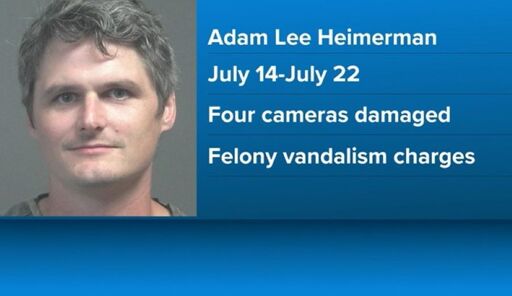
Tennessee congressional candidate Adam Heimerman was arrested for shooting four Flock Safety ALPR cameras, facing felony vandalism charges in the same district debating the tech.
That’s why I called it cute. If I thought someone was actually encouraging firearms-based vandalism and dismissing the public hazard that would create, I would have called it reprehensible.
Ricochet and penetration can happen even if you’re on target. The thin shielding of these cameras isn’t going to do much to stop a bullet. There’s certainly more responsible ways of going about this.
A shotgun with medium-weight birdshot would work well and wouldn’t pose much risk of bullets falling on people. (Birdshot is too light to hold much velocity for long, and even if pellets hit people when coming back down, they’ll be small enough and moving slow enough to be harmless.)
I disagree. If I’m using a can and not wanting to get caught, I’m using subsonic, which, absolutely will not have the energy to do anything.
Even super sonic, you’re talking about a couple hundred yards, max. With the precision of shooting one projectile. Your shotgun is going to be just as dangerous, and shooting a spread. So, good luck not missing your target.
In case you’re curious, I used to run a gun store, and I was an infantryman, I’m not going to say I definitively have more experience than you, but, it’s likely. I know SWAT guys that carry .22 specially for shooting lights.(well cameras these days but they won’t say that)
Eh… I get where you’re coming from, but most birdshot is still significantly lighter than a single .22 slug – especially a heavy subsonic .22
You might be right that subsonic .22 won’t be dangerous by the time it comes back down, but you’re absolutely wrong to say that it’s less dangerous than birdshot.
And I’m still not totally convinced of the harmlessness of .22 at range. Sources I’ve found claim that it can still ‘cause harm’ at up to ~2000m. (Of course it’s by no means a practical round for shooting that far, but that’s because of accuracy issues, not because the bullet isn’t still carrying energy at that range.)
And I really wouldn’t put much stock in the beliefs and practices of “SWAT guys”. Cops are often misinformed about the guns they use, and they tend to only give lip service to public safety.
A .22 shotshell would definitely be safe to shoot up into the air. At that point, though, it starts to become questionable whether it will even do any damage to the camera. (Well, at least it might scratch and pit the lens cover, and that might be enough to make the camera unusable.)


Not if you didn’t miss.
That conditional is doing a lot of heavy lifting.
Skill issue
Cute, but skill issues with guns put people in the hospital.
I think it is what one might refer to as… a joke.
That’s why I called it cute. If I thought someone was actually encouraging firearms-based vandalism and dismissing the public hazard that would create, I would have called it reprehensible.
Ricochet and penetration can happen even if you’re on target. The thin shielding of these cameras isn’t going to do much to stop a bullet. There’s certainly more responsible ways of going about this.
A shotgun with medium-weight birdshot would work well and wouldn’t pose much risk of bullets falling on people. (Birdshot is too light to hold much velocity for long, and even if pellets hit people when coming back down, they’ll be small enough and moving slow enough to be harmless.)
Or a .22. With a suppressor.
I was actually thinking subsonic .22.
Eh, .22 suppressed is good for not getting caught yourself, but could still be dangerous to bystanders if you miss or go through the target.
I disagree. If I’m using a can and not wanting to get caught, I’m using subsonic, which, absolutely will not have the energy to do anything.
Even super sonic, you’re talking about a couple hundred yards, max. With the precision of shooting one projectile. Your shotgun is going to be just as dangerous, and shooting a spread. So, good luck not missing your target.
In case you’re curious, I used to run a gun store, and I was an infantryman, I’m not going to say I definitively have more experience than you, but, it’s likely. I know SWAT guys that carry .22 specially for shooting lights.(well cameras these days but they won’t say that)
Eh… I get where you’re coming from, but most birdshot is still significantly lighter than a single .22 slug – especially a heavy subsonic .22
You might be right that subsonic .22 won’t be dangerous by the time it comes back down, but you’re absolutely wrong to say that it’s less dangerous than birdshot.
And I’m still not totally convinced of the harmlessness of .22 at range. Sources I’ve found claim that it can still ‘cause harm’ at up to ~2000m. (Of course it’s by no means a practical round for shooting that far, but that’s because of accuracy issues, not because the bullet isn’t still carrying energy at that range.)
And I really wouldn’t put much stock in the beliefs and practices of “SWAT guys”. Cops are often misinformed about the guns they use, and they tend to only give lip service to public safety.
.22 also comes in shotshells, tiny little versions of bird shot. I’ve used them on rattlesnakes when needed. We called it snake shot for that reason.
Not saying this is safe in this scenario, but better than a 12 or 20 gauge bird shot.
A .22 shotshell would definitely be safe to shoot up into the air. At that point, though, it starts to become questionable whether it will even do any damage to the camera. (Well, at least it might scratch and pit the lens cover, and that might be enough to make the camera unusable.)
Go get some experience with what you’re talking about.
Sadly, I don’t have access to a 2000m range where I could lob .22LR bullets and see what effects they have on target.
Maybe, but we’re talking about Tennessee