Ironically, same with Japanese. They have an entire alphabet dedicated to foreign words, Katakana. You want a hamburger and a beer? That’s a “ハンバーガーとビール” (Hanbāgā to Biru). Coffee from Starbucks on your way to work? That’s a “ドライブスルーコーヒー” (Doraibusurūkohi - a drive-thru coffee). Better fried chicken than anyone has a right to can be found at the “コンビニ” (Konbini - aka the convenience store). Learning Japanese it’s rife with these borrowed words. Half the time it’s “you’re fucking kidding.” The other half the time it’s learning some insane formalism that makes saying “thank you” take five minutes.
What’s cool is how English then adds those loanwords or portmanteau back into its lexicon like karaoke or, as I’m seeing more recently, egg sando. I really love how languages do that.
He had another one I think recently about a dentist who kept dropping random English words in sentences while talking with Dogen but he had katakana pronunciation so it was basically impossible to understand (one example was he threw in the word “jaw” but said “jō” instead).
Ya Katakana was actually super intuitive if you could recognize and pronounce the symbols. I was amazed at how well I got along there with basically just the alphabet lmaoo.
Awhile back, I watched an anime about camping. It was chill, and cute, and I enjoyed it. But every time they stopped to discuss some kind of camping equipment, it was all English loan words, and it drove me a bit bonkers.
What do you mean Japanese just straight up borrowed the phrase “ground tarp” from English??? Surely they already have words for that!
I’m learning Korean, in South Korea they use so much English vocabulary and it’s all spelled phonetically, for example table (yes they use that word) becomes 테이블 (teibeul) and then you have to pronounce it like a Korean word which always sounds a little weird. Japanese is similar, but the possible syllables in Japanese are much more limited so it ends up sounding even weirder and sometimes isn’t immediately recognisable as English.
They may have. Several Japanese words for everyday objects are taken from other languages despite having earlier words for those things. E.g. bread is pan (from Portuguese) and ball is boru (English).
Though my personal favorite is black hole. Despite having different words for black and hole, black hole is translated as burakkuhoru

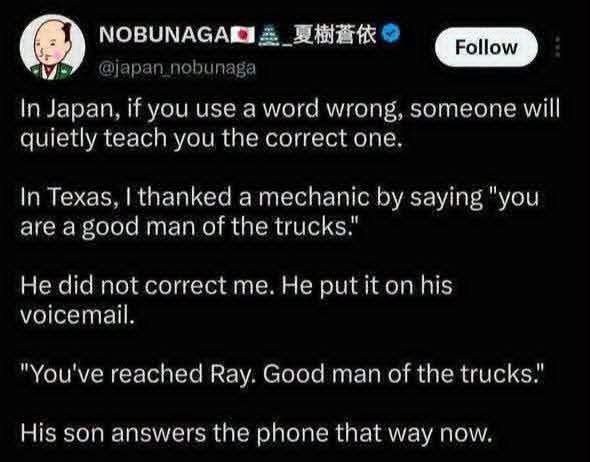
Ironically, same with Japanese. They have an entire alphabet dedicated to foreign words, Katakana. You want a hamburger and a beer? That’s a “ハンバーガーとビール” (Hanbāgā to Biru). Coffee from Starbucks on your way to work? That’s a “ドライブスルーコーヒー” (Doraibusurūkohi - a drive-thru coffee). Better fried chicken than anyone has a right to can be found at the “コンビニ” (Konbini - aka the convenience store). Learning Japanese it’s rife with these borrowed words. Half the time it’s “you’re fucking kidding.” The other half the time it’s learning some insane formalism that makes saying “thank you” take five minutes.
What’s cool is how English then adds those loanwords or portmanteau back into its lexicon like karaoke or, as I’m seeing more recently, egg sando. I really love how languages do that.
Reminder English will happily mug other languages for words, if they are handing new ones out for free? It’s gonna take that new word and run with it.
One of my favorite Dogen videos, about how many loanwords can sound normal in a conversation
https://www.youtube.com/watch?v=pW4AiEqKGto
He had another one I think recently about a dentist who kept dropping random English words in sentences while talking with Dogen but he had katakana pronunciation so it was basically impossible to understand (one example was he threw in the word “jaw” but said “jō” instead).
Ya Katakana was actually super intuitive if you could recognize and pronounce the symbols. I was amazed at how well I got along there with basically just the alphabet lmaoo.
Awhile back, I watched an anime about camping. It was chill, and cute, and I enjoyed it. But every time they stopped to discuss some kind of camping equipment, it was all English loan words, and it drove me a bit bonkers.
What do you mean Japanese just straight up borrowed the phrase “ground tarp” from English??? Surely they already have words for that!
I’m learning Korean, in South Korea they use so much English vocabulary and it’s all spelled phonetically, for example table (yes they use that word) becomes 테이블 (teibeul) and then you have to pronounce it like a Korean word which always sounds a little weird. Japanese is similar, but the possible syllables in Japanese are much more limited so it ends up sounding even weirder and sometimes isn’t immediately recognisable as English.
They may have. Several Japanese words for everyday objects are taken from other languages despite having earlier words for those things. E.g. bread is pan (from Portuguese) and ball is boru (English).
Though my personal favorite is black hole. Despite having different words for black and hole, black hole is translated as burakkuhoru
It’s a syllabary.