
- cross-posted to:
- piracy@lemmy.dbzer0.com
- cross-posted to:
- piracy@lemmy.dbzer0.com
You must log in or register to comment.
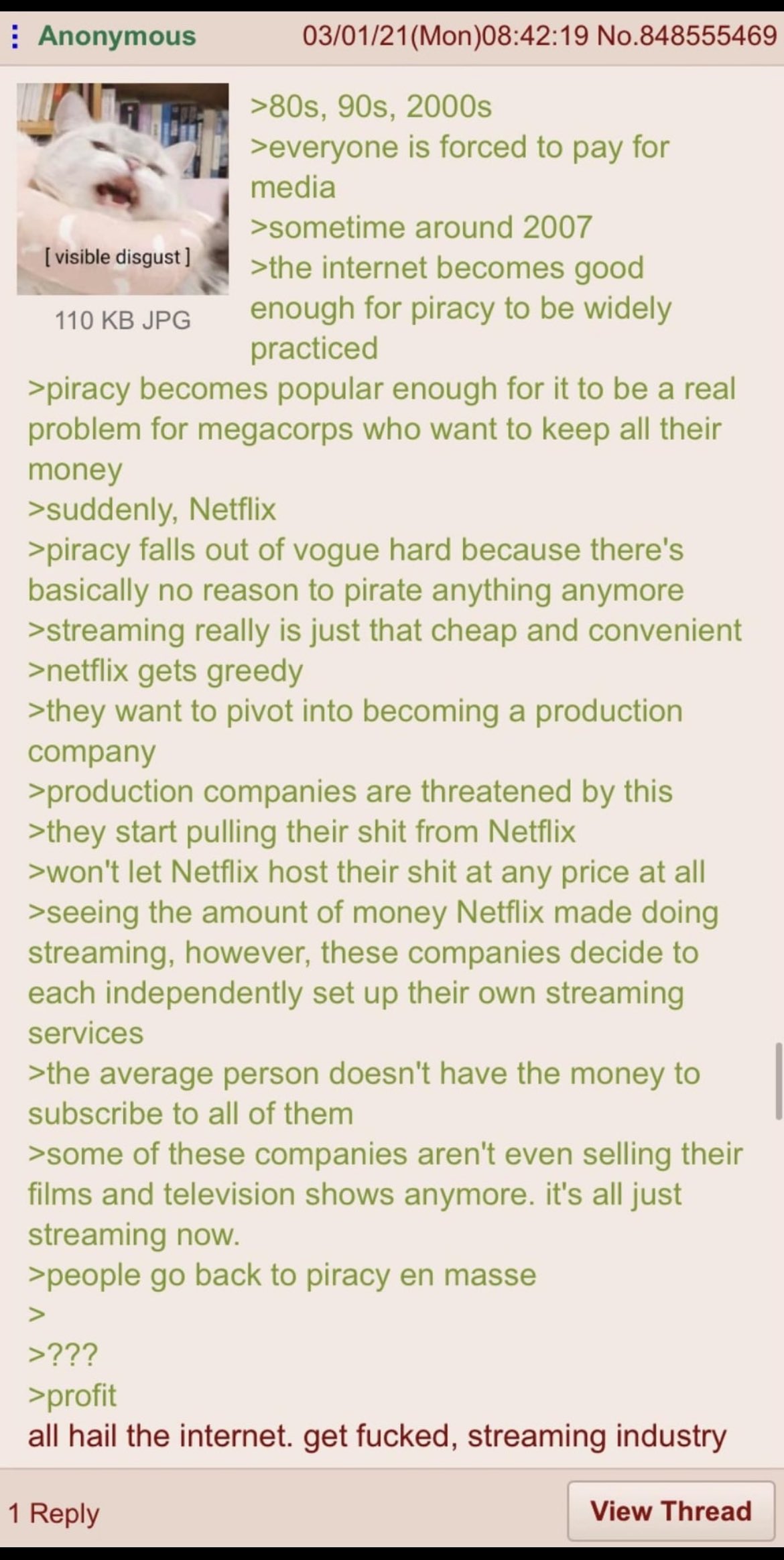
Anon got it backwards, networks noticed how profitable Netflix was and bumped the price for Netflix to stream their stuff. Netflix responded by producing their own content rather than leasing others’ at exorbitant rates. Then Netflix later got greedy and bumped their prices, lowered their quality, and cancelled all of their good shows.
I think it’s a bit of both. Netflix knew that companies choosing to pull their content would be a threat, so they prematurely started producing content (famously starting with House of Cards and Orange is the New Black). Whether because they saw this as a threat or because of the perceived greater profitability of their own platforms (probably a bit of both), other studios started pulling their content from Netflix and setting up their own streaming sites.
And naturally, other companies pulling their content accelerated Netflix’s desire to produce their own content to ensure they weren’t left in the lurch.
Yall are overcomplicating things. Let me simplify.
Capitalist corporations + infinite greed = cannibalism
It’s remarkable how people can see right past what was actually happening and only see what they want to see. Netflix was never trying to be the good guy. Netflix didn’t offer low prices out of the goodness of it’s hearts. It doesn’t have a heart, it has a ledger. The reason why Netflix offered a lot of content for a low price is because the company was trying to disrupt traditional cable. It was always the plan to increase prices, Netflix didn’t become greedy, it always was. It’s just that for a time the companies greed aligned with the publics greed. Once that relationship was no longer beneficial to Netflix it raised the prices, that was the plan all along.
Frankly, I’m unsure if a systemically exploited population can be referred to as “greedy”, NGL.
But that’s a zero sum argument. Every company is evil following that logic. No company does anything except for money.
You can make that argument, but it isn’t unique to Netflix.
You’re getting there! Just a little further, now.
There certainly are some companies that seek to do good, or are run by good people. Arizona Green Tea is the current favourite but there are for sure others. The thing is though that there’re huge incentives to being greedy and awful, and a distinct lack of punishment for that behaviour, to the point where so fucking many of these companies are either evil or committing enough evil actions that it doesn’t matter at all the difference anymore.
Also they weren’t saying that the argument is unique to Netflix but ok then.
soz for necro but Arizona no longer has my whole heart since I got charged $3.50 for a can, they don’t all have {$.99} printed on them anymore :(
When their background image shows up on retail clothing*, that price hike & quiet pivot to resting on their cultural presence to milk their market was only a meter of time. ☝🏼
*IMHO, that shit’s right up there with oversized button-downs emblazoned with copious flames around a serpentine dragon/soaring eagle/howling wolf/et al. 🤦🏼♂️
Whomp, that sucks. It’s about on par, and yea I’ve noticed for a while but unless they’ve changed hands, at some point they do need to survive. In the same way I think wages should go up with inflation, I do understand the need to raise prices from time to time as well. The issue I have is with predatory price jumps, shrink-flation, etc. and doubly when the only people who benefit are the super wealthy at the top.
Wait. They’re gonna start eating each other? Are tix still available, or is it all scalpers now? ✊🏼
I am so confused, i saw this post like 20 minutes ago… how do i have an almost 2y old comment on it?
Anyway i am pretty sure i meant greedy corporations will eventually start exploiting eachother and the systems that allow them to exist.
Ah, that’s just my spicy brain at the helm while I try to caffeinate and retake the bridge. I didn’t even clock the date stamp. 😂
Yes, Netflix famously said they need to be HBO before HBO could become Netflix.
Yeah I consulted for the cable industry around the time that everyone was just starting to try to build their own services to compete with Netflix. It wasn’t a secret that production companies would be pulling their content. There were licensing agreements signed that had expiration dates.
So it was more like a race on both ends. Production companies were like “we get exclusive streaming rights to our movies back in X months, so we need to have our own platform up and running.” And Netflix was like “we lose streaming rights to these movies in X months, we need to make some content to replace it with.”
It doesn’t really matter, though. The only cause of companies pulling their content is Netflix’s success. There was no way Netflix could have prevented it.
Don’t apologize for, much less anthropomorphize, any/all corporations.
You’re doing their work for them —and, for free, FFS. 🤬
RIP Inside Job
Unpopular opinion, but I wasn’t a fan. Was it a bad show? No! Did I enjoy it? Sometimes. How it developed the cult following that it has, I can’t quite piece together. Fantastic voice acting and sound design can only pull so much weight!
An excellent concept with some interesting opportunities, butchered by regressing it to the same kitschy formulaic plotlines as every other uninspiring adult animation show. I don’t want Big Bang Theory, I want Twin Peaks.
Hunh. It’s almost as if the same fucksticks from pre-internet days were suddenly pulling rank on the youngins and handing down decrees of returning to tried & true profit lines —despite that being a shit idea with a volatile, barely-sustainable lifespan.
I didn’t care for it either.
I gave it like 3-4 episodes but couldn’t do it. I thought given the cult following and reputation it’d be right up my alley.
From what it looks like here, I’m kinda relieved I have no idea what that show is.
Except people aren’t necessarily going back to piracy en masse
Torrent sites are dwindling, even the big ones have sad membership numbers compared to 10yrs ago
A large amount of internet users access the internet via devices that are openly hostile to or outright disallow anything that would enable piracy. The devices are then connected to an internet that is further hostile and aims to steer you away from anything deemed unsavory
Phones and tablets are cumbersome and unintuitive to navigate. In the case of apple torrent clients are not allowed to be listed on their app store and sideloading is involved and kind of a pain. Chromebooks and windows 11 are better obviously but less utilized then you’d think
But that leads to the second point, which is kind of angry old man yells at cloud, but people are just less tech inclined now. It makes sense because modern tech is designed to oppress the user whereas tech in the late 90s and early 2000s was more to empower them. They don’t bother to figure out how to install applications, use the file explorer, change settings, etc. the very basic steps needed to pirate shit (you obviously don’t need to be a super hacker). They don’t need to. The command prompt or a terminal is something that makes them think you’re hacking shit
They download applications like steam and then their browser auto opens the installer, then steam handles installing games and mods from that point on. They are safeguarded against having to deal with the icky filesystem and their hand is held every step of the way. Or they just download stuff from the official MS app store and even more hand holding. It’s okay because they’re only gonna install 5 streaming apps anyway and then use the browser to visit the 6 approved websites that google or bing search sends you to for basically any query.
And that’s only if they actually have a proper computer. If they have a tablet or phone they either are pushed extremely heavily towards the above scenario, or in the case of apple they simply have no other option
10 years from now the internet will just be 2-3 social media sites, a few shopping conglomerates, wikis, and streaming sites. The devices used to access will no longer let you access the filesystem directly, apps will be unable to be installed if they aren’t code signed by apple or google or ms or whoever, sealed in epoxy, and draconian drm everywhere. 40 years from now your grandchildren will think you’re weird for complaining about how you used to have autonomy and authority over your devices once you owned them and they’ll remind you it’s time to pay another $400 bezobucks to rent the google chrome ar internet hub for another month because you’re not allowed to own it and it’s a federal crime to take it apart
Direct download piracy and streaming is surprisingly popular.
With a bit of effort you can stream any movie directly to your TV for a few moneys a month (or free, but paying for the essential bits removes the jankiness)
Basically you select the movie, a system finds the torrent or DDL, a service downloads it (or has it cached) and you stream it to your device.
With a bit of effort you can stream any movie directly to your TV for a few moneys a month (or free, but paying for the essential bits removes the jankiness)
Something I learned back in the day: “Never pay for warez”. Pirate all you want, the moment you are paying, pay the creator of the product you’re interested in, not someone who pirated it and wants to profit from distributing it without a licence.
Except the value proposition still needs to make sense, so resigning to just pay the
creatorlicense holder exorbitant rates for ever-more-enshittified services is learning the wrong lesson.They have used their control over the system to grotesquely distort copyright from its original intent of getting more cultural works into the public domain for people to use and build on, to instead lock everything away for lifetimes. Don’t buy into their lies and propaganda that they have any moral high ground.
While I agree with the trend for the average person, I think in pure numbers there are always going to be more tech savvy people in the foreseeable future.
Sure, 80% of people online in the 2000s and 90s were all tech savvy hobbyists, but their numbers was low (let’s say a million).
Now only 0.5% might be tech savvy, but that is 0.5% of a billion people, which would be 5 mil compared to 800k above.
I obviously picked convenient numbers but the point still stands, there are lots of tech savvy places today and it’s growing, just not as fast as the non tech savvy crowd unfortunately.
I am personally still friends with two people who even know how to navigate their filesystem beyond clicking the downloads or my documents link in the start menu. I hope you’re right, but all I see around me at work and personal life is ignorance. People can’t even figure out how to use their phones beyond the basics.
Yeah, on average you will find less and less tech savvy people in real life moving forward.
But if you were to ask a programming question on the most popular coding site, you would get more responses today than 20 years ago.
2007? I remember watching a DivX of The Matrix back in 99. Prior to that I remember watching south park episodes in the RealPlayer.
Those RealPlayer Southpark episodes were 15mb and had 8 pixels
2007? Anon is a sweet summer child.
I’ll say. I was sailing the seas back in the late '90s. By 2007, I had amassed quite a hoard of treasure.
Exactly this and more.
I’m not even pirating because it’s cheaper, or easier. I have near 100TB in storage, and it takes hours per week to search material, have it downloaded, checked, etc. I just am done with the marketing, the branding, the advertising, the bullshit rules. I just want to watch what I want to watch and media companies made this impossible so I’m forced to sail the high seas
100TB? Why?
Because its fun. Because i get obscure movies in high quality, maybe for posterity? I dunno, it’s a hobby. Why does anyone get a Warhammer 40K army?
I feel like people are ignoring that Netflix was bleeding money during their “golden age”. They only switched to being profitable a couple years back. A lot of times what people describe as enshittification is just unprofitable companies having to come up with an actual business model as venture capital dries up.
Also, merry Christmas:)
You can also argue that silicon valley has that particular business model of purposely making a product look great and cheap until enough people sign up.
It’s distinct from how most companies run in the red at their inception in that those traditional businesses would gladly be in the black but are waiting for economies of scale or building a reputation among consumers.
Anon: 2007
The music industry ca. 1981: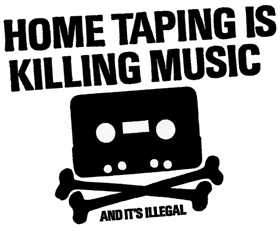
Also the book piracy that existed in universities through photocopying and sharing pages.