

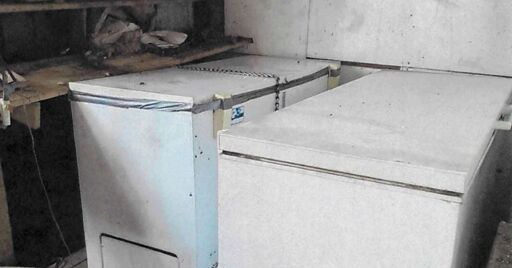
Another article about the same case makes this smell even more like The Onion: https://www.mtvuutiset.fi/artikkeli/vanhempansa-pakastanut-mies-perustelee-tekojaan-jopa-muinaiset-faaraot/9391918
An elderly doctor says he froze his parents’ bodies at his father’s request. During police questioning, he spoke of pharaohs, catacombs, and Elon Musk.
“My father’s wish for me, as his eldest son, was that his body be mummified and preserved, and not disposed of by society through cremation or burial,” the man said during police questioning.
He says his father advocated for “ecological diversity, a pleasant lifestyle, and freedom of religion and funeral rites.”
“Even the ancient Egyptian pharaohs spent half their lives preparing for death. So did the richest man in the world, Elon Musk, who wants to be buried on Mars. I’ve heard this from my father before.”
According to the son, he was supposed to build a burial chamber for his parents. At first, his father had asked him to build the burial chamber in the United States. The family’s third child, the sons’ sister, has lived in the United States for several decades, and according to the son, his parents visited her there every summer.
“My father believed that his body would remain ‘forever’ and allow future archaeologists—if they were so inclined—to study what the human body was like back then. This isn’t some delusion of grandeur, but rather a product of the thinking of that era,” the man explained.
He said he must fulfill his father’s request to the end.
“This must be seen through to the end. I have promised, and I have a sacred duty to build the burial chamber and prepare the eternal coffins,” he said.
Archeologist studying bones in a long-unpowered freezer:
“Serial killer. Definitely a serial killer.”
And millinia later someone recovers some chronoradiography data proving it was a ritual suicide to achieve divine preservation through bulk paper roll storage in the tomb.
I wonder if it’s possible to affordably DIY a freeze dryer large enough to hold a human body. In principle such an innovation would allow low-cost, low-skill DIY mummification.
Sure. If you wait long enough, any freezer is a freeze dryer. Thats what freezer burn is.
Freeze drying machines just speed the process up with heat cycles, vacuum, and possibly some circulation at certain points in the cycle. But importantly, in order for freeze dryer machines to actually work decently, the material needs to be cut into very small, fairly even chunks.
Whole bodies are one case where sublimation alone is probably the best bet, maybe make the whole thing a vacuum chamber to drive moisture out faster, but skip the heat part. Importantly, this apparatus would never be cheap if you install anything other than freezing capabilities. Vacuum chambers are difficult to make, and they would need to run for a very long time to fully dry a body.
But the takeaway is if this guy was telling the truth about his absolutely unhinged plans, he at least stumbled upon a solution that would eventually preserve a body. Its a very fragile preservation, but it could work, sure.
I suppose especially if the freezer had a drain line and a defrost cycle, a regular freezer would dry out a body quite effectively over a long enough time. (Ideally you would remove the moisture from the freezer entirely, not just leave it in the freezer as ice. Maybe a DIY approach to mummification could go like this:
The problem with just freezing the body, without removing the moisture, is that to me this isn’t true mummification. To me at least, a “mummy” is something that can be left in ordinary room-temperature conditions and not undergo further decay. While freezing a body will preserve it while cold, the minute you warm it back up it will start to rot. To be a proper mummy, it has to be able to survive outside of the freezer. Removing moisture would be critical for this.
I don’t know why I’m writing about this. But sometimes it’s fun to approach unhinged problems from a real engineering point of view. Sure, you can read a book on how the ancient Egyptians did mummification, but that’s not exactly replicable today by ordinary people using commonly available materials. The Egyptian technique requires a lot of skill, many specialized tools, and a lot of rare ingredients. What I’m wondering is with modern technology, if there’s a way to democratize mummification, to allow it to be approachable by the common man using readily available tools and materials with little requisite knowledge required.
I don’t think freeze drying is ever going to be true mummification (based on your definition of storing it in room conditions) regardless of if there’s a mechanism to remove moisture from the freezer space.
The long-term freezing process itself dries out the body, so its just a matter of waiting before it fully dries out, that part isn’t a problem, and nothing extra really needs to be done to dry it, but what you are left with is basically a sponge of organic material that will want to soak moisture from the air. So so much surface area for moisture to settle into, and then your super dry person starts to get a sheen of mold…
But in total fairness, no mummies can actually be stored in room conditions without degradation for exactly the same reason. Museums put them into climate controlled cases and work very hard to make sure they don’t deteriorate. The only reason Egyptian mummies survived as they did was that it’s pretty dry in the desert, and those tombs were pretty well sealed from weather fluctuations. Most (perhaps all, but im not confident enough to say that) other mummified bodies we’ve found have been frozen. I think (though I’m open to correction here) those basicallly have to stay frozen, or they start to deteriorate. (These didn’t fully dry out because they were encased in ice)
There’s also bog mummies who stay preserved because they’re in an anaerobic environment
There are also swamp mummies that happened because the swamp may lack oxygen that is needed for proper decomposition. Those are not human-made, of course
Some are human made, sure it’s just by dumping a corpse into a bog, but we have evidence of the Irish doing just that (though we don’t know if it was to preserve them)
Oh, TIL, thought it’s too random for use by humans