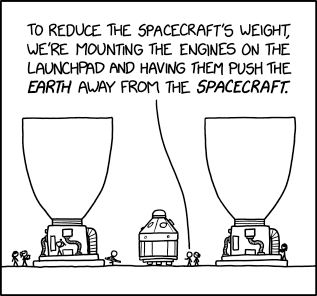
Title text:
It does come at the cost of some launchpad expansions and increased fuel requirements, but that all comes out of the facility’s budget.
Transcript:
Transcript will show once it’s been added to explainxkcd.com
Source: https://xkcd.com/3291/
Kerbal launch cannon go brrrr

From the “Futurama solves global warming” school of thought.
Also a Phineas and Ferb episode.
It’s Always Sunny In Philadelphia theme plays
The Gang Launches a Spacecraft
I thought of Futurama too, but instead how the Ships engines move the Universe around IT
It came to me in a dream, and then I forgot it in another dream.
That’s a complete load!
Nothing’s a complete load! Not if you can imagine it; that’s what being a scientist is all about!
Don’t dream it, be it.
rip
no, it’s only a third of the load. i left the other two thirds with a friendly laotian couple.
I thought that was a silly joke but that’s actually more or less how an alcubierre drive would work.
Is it though?
Giant chemical engines to push a planet away is like bending space around a spacecraft?
The giant chemical engines were not being compared to the alcubierre drive. The commenter was discussing how the engine of the ship in futurama, which “moves the universe around it” would fairly neatly describe the function of an alcubierre drive in layman’s terms. This is why you were downvoted.
I don’t know why you got downvoted for what seems like a reasonable question. I think it might be the lateral nature of the solution that is comparable.
I was thinking of the robots all firing their exhaust upward to push earth away from the sun.
You laugh, but China made a big-budget action movie about this very concept.
True! Based on a Liu Cixin story. Never read it but loved his Three Body Problem series.
The Wandering Earth.
Incredibly silly movie, but a fun watch!
It was good
This reminds me there was a project about 10-15(?) years ago where they were trying to rig the F15 with an attachment to launch satellites in quick need situations. The F15A shot down a satellite in 1985, so it makes sense it could put one up there as well. Think they ended up terminating the program because it became cheaper to launch them in mass.
Aka they probably just took it out of the public eye
no they cancelled it because thats impossible lol. you can shoot a satellite with a suborbital object but thats a loooong way from the projectile being orbital. shooting a satellite that way is more analogous to laying down a spike strip for a car. almost all the velocity of the impact is coming from the satellite not the projectile.
theres a reason even the smallest orbital rockets are the size of a building, its all the propellant required to get there. theres just no way to get that into an F15, to say nothing of the limitations of an airbreathing engine. the skylon was an attempt at a single stage to orbit vehicle using an air breathing engine and it was so complicated and impractical they never even got past the engine precooler design.
You’re not totally right. A jet engine can provide a large amount of the ∆V required to get into orbit, so your orbital injector could be significantly smaller than a full orbital rocket.
Yeah, a mixed-mode engine is probably not the ideal. You’d probably just use a liquid fuel rocket carrying oxidizer, like every other orbital rocket, as the payload on the jet, but you’d get to skip a large portion of the launch. Keep in mind that the rocket equation means that most of the fuel is used for the initial portion of the launch. If we can have an air breathing jet handle that then the rocket can be significantly smaller.
If you’re just trying to insert a single small payload into orbit, it makes some sense. It’s very limited by the capabilities of the aircraft though, obviously. A rocket can do significantly larger payloads with more versatility, so it ends up being more practical per ton of payload.
I was sad to see Reaction Engines go, they were local-ish to where I grew up.
yeah i first learned about them going through engineering school and thought it was the coolest project id ever heard of. when i learned that they started the project before i was born it was like, oh… this is never going to fly lol.
Its roots were even older too I think.
no they cancelled it because thats impossible lol. you can shoot a satellite with a suborbital object but thats a loooong way from the projectile being orbital.
Nah, it’s not that long a way. You just need to adjust your goals, add an extra stage, accept a much smaller payload.
If you can get a payload to space, you could put a payload 1/4 its mass into orbit with an additional stage.
I mean, the anti-sat F-15 test was pretty wild. But is arguably less wild than other airlaunch systems like the Pegasus or spaceship one. Saying that airlaunch is impossible is silly, because it’s happening.
These systems get cancelled because they’re expensive and complicated and reusable rockets are cheaper and easier.
They are saying a missile that went faster than, and tracked a target at orbital speed and velocity, can’t be reached… Obviously it can, or they’d miss everytime. Yet they shot it down using a rocket deploying a payload 41 years ago. Same shit, different payload.
thats not what i was saying at all. hitting an orbital object with a projectile is obviously possible. what im saying is that the velocity required to get a projectile in the right place at the right time is at least an order of magnitude less than the velocity required for it to be an orbital projectile.
It’s 1 moment to land am object that can land relative location with a small amount of fuel to readjust course. Like most other projectiles we shoot. On a scale of 1/10. If landing a shuttle on a landing pad is a 8/10 that’s. 3/10
ok so because you dont seem to be understanding the astronomical difference in velocity between a plane, a missile, and a satellite ill go through the comparison. in the most favorable possible terms. choosing the AIM-54 phoenix missile because its the fastest missile i was able to find with a quick search.
F15 maximum speed: 738 m/s
AIM-54 Phoenix maximum speed: 1700 m/s
Low earth orbit velocity: 8700 m/s
so adding the plane and the missile together we get 2438 m/s, which means the missile would need to gain 6262 m/s of additional velocity to reach orbital velocity. this corresponds to an 11.7 times increase in kinetic energy.
so the F15 flies up, works as hard as it possibly can to get to maximum speed, then shoots its AIM-54 phoenix missile which uses all of its fuel to get to its maximum possible speed, a tiny nudge for maneuvering is going to add 11.7 times more kinetic energy and nearly quadruple its speed… yeah that missile could hit a satellite, but it will never become a satellite itself.
all of this completely ignores the delta-v losses to gravity, steering, and drag required for an orbital insertion trajectory, so things get much much worse from here. if you’re actually interested in this i suggest you look up some youtube videos on orbital launch vehicles. or just believe whatever you want. the tyranny of the rocket equation is such that it doesnt really care what you think.
So let’s just say we had missiles that can go 9000 meters per second. (Russia, China and the the U.S. already do). You believe those are impossible as well? The term impossible is my problem with your statement.
Just because no one has shown a tool designed to do it yet doesn’t make it impossible. Your math showed it was possible.
The issues come down to weight and fuel sources used. Once you have the payload going in the speed/tragedy needed, yes it would need to be able to correct itself. When we launch 20+ satellites, they all have similar instruments in them, they aren’t all just dropped into 1 orbit
air launch is dumb. it provides almost no benefit from a deltaV perspective while dramatically increasing the engineering cost and complexity of the launch system. just because people are working on it doesnt mean its going to be useful or practical or even work. even if it does eventually work for someone someday it wont be worth the effort or cost. theyll cancel it after a few launches or go out of business because no one can afford their overpriced copium machine.
Wouldn’t the main benefit to air launch be the elevation gain? Flight through wings is way more efficient than just raw thrust
I think the main advantage of air launch is there is less air in the way.
If you didn’t have any air resistance you could go faster earlier and reach orbit faster. This means less fuel wasted on fighting gravity, but because we have an atmosphere, there is a speed limit.the elevation gain is a marginal benefit compared to the velocity required. no plane is going to give a meaningful velocity as a first stage, and at best will give not nearly enough altitude to matter, while severely limiting the maximum mass of the rocket.
just for some context, the energy to lift 1kg to an altitude of 500 km is 4.9 MJ (being extremely generous and assuming constant surface gravity), while the energy to accelerate 1kg to a velocity of ~7.6 km/s (the required velocity for a circular 500km orbit above the earth) is 28.9 MJ. so even if the plane could magically get the rocket all the way to altitude, it only saves about 14.5% of the energy required to achieve orbit.
practically speaking its likely impossible for a plane to get past the karman line (100 km) without the assistance of a rocket engine, and according to wikipedia the altitude record for a jet plane is only 37.6 km, which is only 7.5% of a 500 km orbit. its just way easier and cheaper to make a bigger rocket than to bother with putting a rocket on a plane.
I mostly agree. It’s not an efficient way to get to orbit.
It was an early attempt at reusable launch vehicles, it was a good idea, that turned out to be overcomplicated. The Pegasus 100% worked though, it went to orbit, so it’s not a question of “could it work someday”, it did work, it was just more expensive than the standard methods.
Again, I’m not saying this is an avenue worth exploring, I’m just saying that it’s incorrect to call it impossible.
Everything you just said was confidently false.
yeah sure believe what you want lol. the rocket equation doesnt care about your conspiracy theories.
Show your math.
The end with lots of fire coming out should point towards the ground.
If it points towards space, that’s a big problem, and we will not go to space this day :/
Sounds like a Scott Manley quote.
Haha that’s awesome. It’s also xkcd
I still say we should mount rockets into a rollercoaster rail🎢 that way stage one can be spent on the ground doing a horizontal launch and then the rail would have to change the angle to be more horizontal
This was actually tested in 2001 and found to be effective method to launch a crew into space
Sweet now I have a working example to show. Also I remember seeing jimmy neutron movie in theaters
i remember the 2000s being a lot less colorful. and pointier.
Sure, it’s just 2000 kilometers long. We’ll just take over the northern half of Brazil to build it
You need a bit less than 1/3 of it…
But it’s supposed to be build in an ocean. Forests do not make for good logistics.
(It’s also supposed to use a series of hypersonic iron pellets running inside a tube, that will explode and endanger a hundreds of km radius if something like even an air leak appears there… So yeah, the size is the least of the issues here.)
Just do it in the winter, otherwise it might get too hot…
STOP GIVING ELON IDEAS
Wrong approach, if they are going to the moon they need to attach engines to the moon and bring it closer
No new idea under the sun
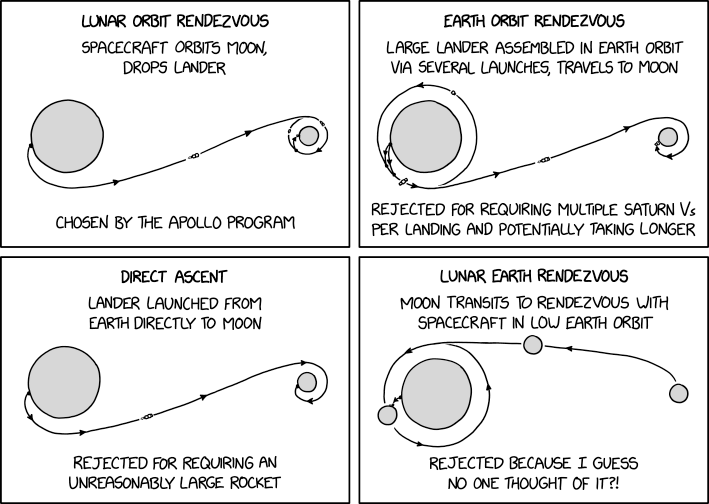 https://xkcd.com/2909/
They have to get to the moon first to attach the engines, only then will they be able to do this
You should not be getting blocked by a small problems like this, think big!
not the moon, but maybe smaller asteroids. nothing large enough to affect tides.
Ah good thinking
This kills the planet. ☹️
The planet is fine. The people are fucked.
Nah, it’s fine, you just have another launch, 12 hours later, to push it back. That’s bound to work, right?
If it starts pointing toward space you are having a bad problem and you will not go to space today.
deleted by creator
Eh, Niven did it first.