

- cross-posted to:
- programmer_humor@programming.dev
- cross-posted to:
- programmer_humor@programming.dev
Reposting because it was removed from another comm earlier for the political content.
Reposting because it was removed from another comm earlier for the political content.
Geez, Picard Maneuver’s comment was bad enough, but you just had to go and twist the knife!
At least copyleft-licensed (e.g. GPL), as opposed to permissively-licensed (e.g. BSD), Open Source software is about as anti-corporate as it’s possible to get. That’s why Apple switched from bash to zsh, for example: they wanted to get rid of the copyleft. It’s also why stuff like Alpine Linux is a dangerous trend.
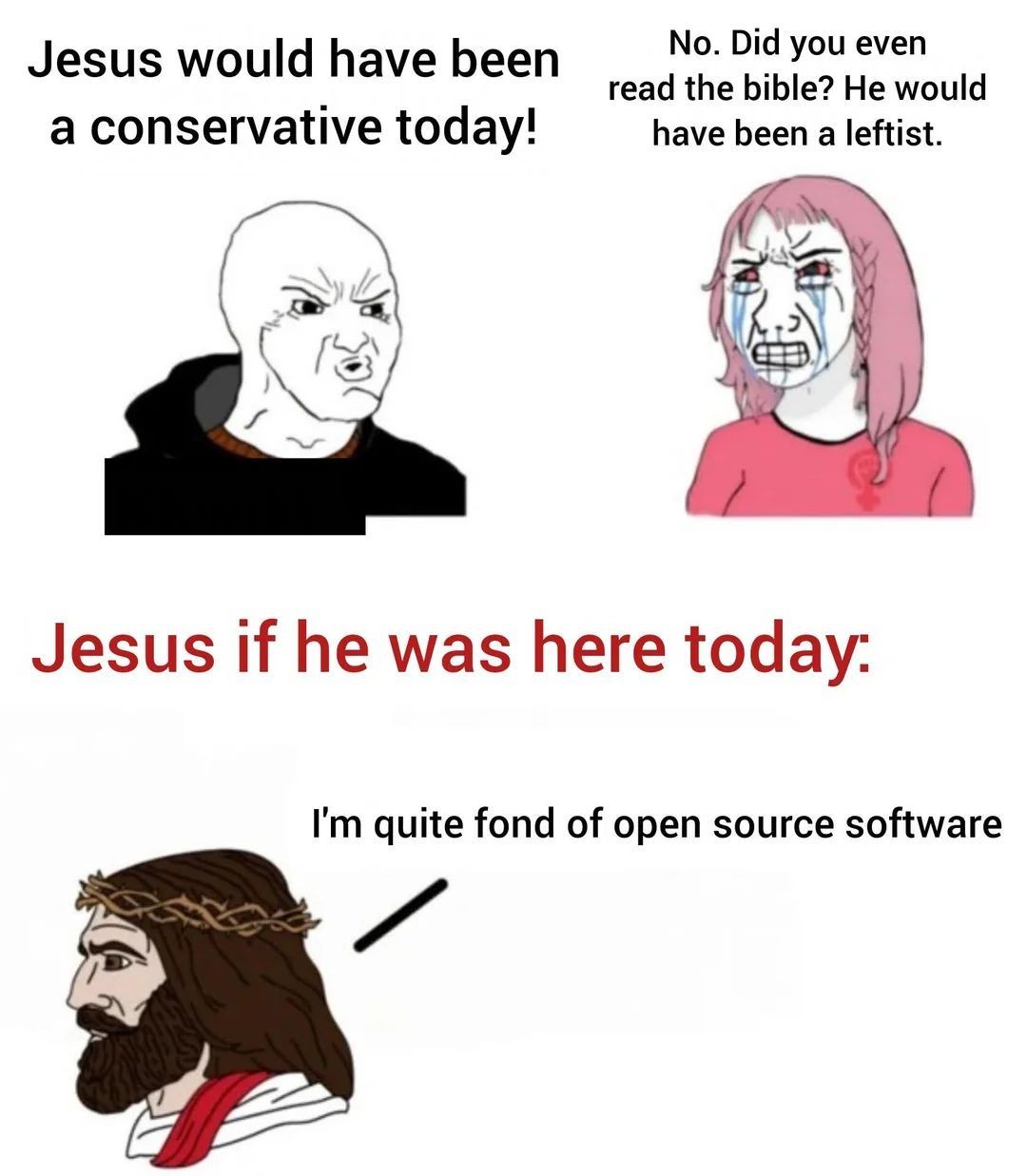
I think Jesus would be very fond of copyleft licensing, as it is specifically designed to withhold control from those who would exploit it and thus keep users ungovernable.
I know nothing of Alpine linux. What is it that they’re doing that would be a dangerous trend?
Alpine Linux swaps out GNU libc, GNU coreutils, and systemd for musl, BusyBox, and OpenRC, which have weaker licensing (MIT, GPLv2-only, and 2-clause BSD respectively, vs. GPLv3+ for the GNU stuff and LGPLv2.1+ for systemd). Part of the reason for it is to be lighter and smaller to be more useful for embedded systems and containers, but it also has the effect of making it more attractive to corporate exploitation.
In general, the more popular permissively-licensed stuff gets compared to strong-copyleft stuff, the easier it is for corporate bad actors to do things like TiVoize it or go closed-source entirely.
The software was already corporately exploited. Not much lost here. In fact, I would argue that BSD licensing keeps projects more free of corporate influence if started by hobbyists.
Corpo forks BSD/Apache/whatever software, doesn’t publish source, nerds don’t use it and look for the original, the end.
Corpo forks copyleft software, publishes releases on GutHib with literal zip files in the repo semi annually. Original maintainer gets taunted with “but the corpo one has feature X, the code is free, you should use it”. If they don’t merge it, they get labeled an egoist and people go use the corporate one. If they do merge it, eventually the entire project gets bloated and barely readable, is held together by @redhat.com patches, and eventually all development is just corporate decisions. There’s no escape.
You know, we are all victims of it ourselves. I am using Firefox rn. There was little to no “conversion” as they started out corporate. They have patches merged from the Tor people for actual privacy, although removed from the settings because “meh, nobody would want that” (sponsors would disapprove). The privacy they are marketing for normies is a list of like 20 domains.
It’s all corporate decisions. While I don’t use the specific variant(s) and didn’t observe it, I once saw the Firefox home page on someone else’s device. It was football stats followed by “sponsored links”. I thought it was Edge for a second.
And there’s no escape. Web pages are no longer actual pages oftentimes, they are fat blobs of 3 language conversions on top of each other targeting only the specific 3 (sometimes 2) big brand web browsers as the backend: Firefox, Chromium and Apple’s Webkit fork. They are all corporate. The fat blob generators are also corporate.
That’s why I said generally…copy left is great, I totally support it. But it also has the issue that without corporate donations, it’s hard for developers
Jesus’s whole thing was breaking out of the system through community though. Why would he care about most software? He’d probably try to get people off screens to engage more with the people around them