“Cashier” has pretty much always been a heavily exploited, poverty-wage position. Cashiers might be putting food on the table, but their dickhead bosses aren’t paying them a living wage. They aren’t putting roofs over heads, or kids through college. Turnover is ridiculously, criminally high. People aren’t getting fired when the position is eliminated. They are leaving just as fast as they already were, and they aren’t being replaced.
The position is used to systematically exploit workers. Eliminating that position is a net positive.
True. Very true. But the solution to that problem is a completely different conversation than what we have been having in this thread. That conversation starts with a “citizenship dividend”.
Democracy takes the political power of the individual, conveys it to government, where it is used to provide all manner of services. Those services are available to everyone, but they are not utilized equally by everyone.
The individual is not currently compensated for the use of their political power. We are taxed proportional to those services that we use, but those taxes don’t make it back to the source of the power that enabled those services.
That should change.
Each of us should be individually compensated for the government’s use of our political power. We should each receive an equal dividend. The most common term for this dividend is “Universal Basic Income”, and it should be enough for the food on our tables and the roofs over our heads. We should receive that income before we get out of bed on Monday morning. The 40 hours we typically work in the week should not be for basic subsistence, but should be entirely gainful.
If your cashier’s are not making a living wage, then maybe the minimum wage should be increased?
Where I am, if a minimum wage worker worked 40 hours a week consistently, they would go home with the equivalent of $26k USD. The US Federal minimum wage at 40hrs/week will net you $15k USD.
The job isn’t always for the impoverished, and if it were, and you were to eliminate it, you just put people who are already impoverished into homelessness because they no longer have any viable means of employment.
The people leaving the job is a net positive because they should be, in theory, moving on to better paying positions. Freeing up jobs for people who need the work and can’t find it elsewhere.
It’s better than working in an Amazon warehouse.
Also, I worked at grocery stores a lot when I was a younger person and I was never a cashier, but I knew most of them and I was able to go back there years and years after I left and see the same faces at the tills. A lot of wives with empty nests helping to save up for retirement, or simply to do something during the day while their kids are off at school or whatever…
A lot of people working to help pay their way through college or university.
There were a lot of people working at those jobs for years and years because they needed something to help make ends meet until they could graduate, retire, find a job in their field, pay off their mortgage… Whatever it was.
You having this opinion indicates to me that you haven’t worked at a major retailer, or you’ve never worked as a cashier. I’m not sure which and bluntly I don’t really care. My lived experience disagrees with your pessimistic world view.
If your cashier’s are not making a living wage, then maybe the minimum wage should be increased?
Minimum wage is certainly too low. It should be more than double its current hourly rate, but that’s not the main problem here.
Where I am, if a minimum wage worker worked 40 hours a week consistently,
Cashiers are rarely allowed to work full-time hours. Management keeps the position open only for part-time workers. Cynically, the reason for this is so they don’t have to provide benefits to those workers. Giving retailers the full benefit of the doubt, this keeps a surplus of workers on the payroll, allowing the retailer to schedule everybody during major shopping events like Black Friday. Regardless, these workers are typically denied sufficient hours to be able to earn a living wage.
The job isn’t always for the impoverished,
You’ve got it backwards. The job isn’t for workers who happen to be impoverished. The impoverishment is because the job does not compensate workers adequately.
Also, I worked at grocery stores a lot when I was a younger person and I was never a cashier, but I knew most of them and I was able to go back there years and years after I left and see the same faces at the tills. A lot of wives with empty nests helping to save up for retirement, or simply to do something during the day while their kids are off at school or whatever…
So, you’re saying that these workers are holding these jobs for something other than gainful employment? They are using them as some sort of hobby or recreation? They are willing and able to accept exploitative conditions because they aren’t actually trying to live off the fruits of their labor?
The people you are talking about are, ultimately, enabling this exploitative behavior from employers. They are competing for work with people who do need actual gainful employment. Their recreational participation in the workforce devalues the labor of everyone else. I’m not saying they shouldn’t be allowed to work recreationally, or that employers shouldn’t be able to hire them. I’m saying that this practice should be strictly regulated, so that the employer can’t use their willingness to be exploited to justify exploiting everyone.
I think we need to establish both a “minimum wage” and a “standard wage”. The minimum wage would be the fixed, hourly minimum rate that we already have . The “standard wage” would multiply the minimum wage by 40 hours a week. Employees who aren’t paid at least that weekly amount are on “substandard employment”. A 40-hour/wk worker earning minimum wage makes a standard wage. A 20-hour/wk worker earning 2x minimum wage makes a standard wage. Substandard wages should be allowed, but restricted. An employer should not be allowed to compensate more than 10% of its labor with substandard wages.
I see what you’re driving at, but all employment is exploitative. There’s always a measure of the work that any low-level employee does that they will not get compensation for, that’s how business operates. That’s profit.
Whether someone is able to work at a position full-time or not, isn’t really the point I’m making here. Long gone are the days of the minimum wage being a living wage, no matter how much we try, we’ll never catch up to the inflation that’s happened since the minimum wage was set. Companies won’t let it happen. As minimum wages go up, so will prices, and you’ll always be in a never-ending cat-and-mouse game of raising wages, vs raising prices. The two will never be at the same ratio of earnings again. Minimum wage earners will never have the same buying power that they did when the minimum wage was put in place.
Our buying power will continue to be eroded away, in small amounts, forever. Minimum wage positions will always be, by definition, more exploitative than other positions, but all jobs are going to continue to exploit the work that people do. That’s capitalism in a nutshell though. I’m not proposing a better system, just stating facts. That fact makes a lot of what you’re driving towards, apply to a much broader group of people than just the exploited minimum wage, impoverished workers. The lowest earners will always need to be supplemented by something, whether that’s a food bank, food stamps, rent control, government programs to reduce costs, taxes, or other fees associated with living, or by the income of another person. I don’t think Minimum wage earners will ever be able to be financially independent, even if they could have been at one point or another.
By cutting any job, you’re shrinking the pool of jobs available for entry level workers. A pool that’s continually shrinking already. I will happily do whatever I can to reduce how much that’s shrinking as often as I can.


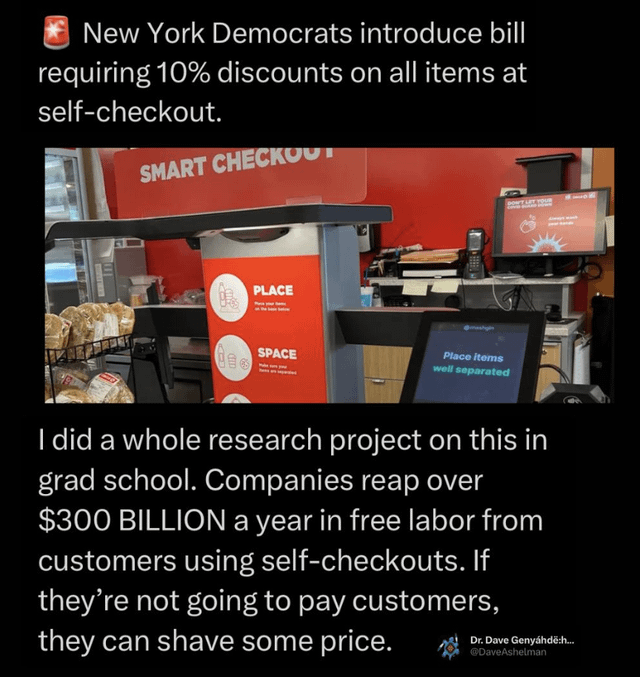
“Cashier” has pretty much always been a heavily exploited, poverty-wage position. Cashiers might be putting food on the table, but their dickhead bosses aren’t paying them a living wage. They aren’t putting roofs over heads, or kids through college. Turnover is ridiculously, criminally high. People aren’t getting fired when the position is eliminated. They are leaving just as fast as they already were, and they aren’t being replaced.
The position is used to systematically exploit workers. Eliminating that position is a net positive.
And yet people still work as “Cashier” if they can get the job,
Wonder why…
Oh, wait, it’s because the alternative of having no job and no income IS EVEN WORSE.
Welcome the Capitalism!
True. Very true. But the solution to that problem is a completely different conversation than what we have been having in this thread. That conversation starts with a “citizenship dividend”.
Democracy takes the political power of the individual, conveys it to government, where it is used to provide all manner of services. Those services are available to everyone, but they are not utilized equally by everyone.
The individual is not currently compensated for the use of their political power. We are taxed proportional to those services that we use, but those taxes don’t make it back to the source of the power that enabled those services.
That should change.
Each of us should be individually compensated for the government’s use of our political power. We should each receive an equal dividend. The most common term for this dividend is “Universal Basic Income”, and it should be enough for the food on our tables and the roofs over our heads. We should receive that income before we get out of bed on Monday morning. The 40 hours we typically work in the week should not be for basic subsistence, but should be entirely gainful.
I’m going to disagree with you there.
If your cashier’s are not making a living wage, then maybe the minimum wage should be increased?
Where I am, if a minimum wage worker worked 40 hours a week consistently, they would go home with the equivalent of $26k USD. The US Federal minimum wage at 40hrs/week will net you $15k USD.
The job isn’t always for the impoverished, and if it were, and you were to eliminate it, you just put people who are already impoverished into homelessness because they no longer have any viable means of employment.
The people leaving the job is a net positive because they should be, in theory, moving on to better paying positions. Freeing up jobs for people who need the work and can’t find it elsewhere.
It’s better than working in an Amazon warehouse.
Also, I worked at grocery stores a lot when I was a younger person and I was never a cashier, but I knew most of them and I was able to go back there years and years after I left and see the same faces at the tills. A lot of wives with empty nests helping to save up for retirement, or simply to do something during the day while their kids are off at school or whatever…
A lot of people working to help pay their way through college or university.
There were a lot of people working at those jobs for years and years because they needed something to help make ends meet until they could graduate, retire, find a job in their field, pay off their mortgage… Whatever it was.
You having this opinion indicates to me that you haven’t worked at a major retailer, or you’ve never worked as a cashier. I’m not sure which and bluntly I don’t really care. My lived experience disagrees with your pessimistic world view.
Minimum wage is certainly too low. It should be more than double its current hourly rate, but that’s not the main problem here.
Cashiers are rarely allowed to work full-time hours. Management keeps the position open only for part-time workers. Cynically, the reason for this is so they don’t have to provide benefits to those workers. Giving retailers the full benefit of the doubt, this keeps a surplus of workers on the payroll, allowing the retailer to schedule everybody during major shopping events like Black Friday. Regardless, these workers are typically denied sufficient hours to be able to earn a living wage.
You’ve got it backwards. The job isn’t for workers who happen to be impoverished. The impoverishment is because the job does not compensate workers adequately.
So, you’re saying that these workers are holding these jobs for something other than gainful employment? They are using them as some sort of hobby or recreation? They are willing and able to accept exploitative conditions because they aren’t actually trying to live off the fruits of their labor?
The people you are talking about are, ultimately, enabling this exploitative behavior from employers. They are competing for work with people who do need actual gainful employment. Their recreational participation in the workforce devalues the labor of everyone else. I’m not saying they shouldn’t be allowed to work recreationally, or that employers shouldn’t be able to hire them. I’m saying that this practice should be strictly regulated, so that the employer can’t use their willingness to be exploited to justify exploiting everyone.
I think we need to establish both a “minimum wage” and a “standard wage”. The minimum wage would be the fixed, hourly minimum rate that we already have . The “standard wage” would multiply the minimum wage by 40 hours a week. Employees who aren’t paid at least that weekly amount are on “substandard employment”. A 40-hour/wk worker earning minimum wage makes a standard wage. A 20-hour/wk worker earning 2x minimum wage makes a standard wage. Substandard wages should be allowed, but restricted. An employer should not be allowed to compensate more than 10% of its labor with substandard wages.
I see what you’re driving at, but all employment is exploitative. There’s always a measure of the work that any low-level employee does that they will not get compensation for, that’s how business operates. That’s profit.
Whether someone is able to work at a position full-time or not, isn’t really the point I’m making here. Long gone are the days of the minimum wage being a living wage, no matter how much we try, we’ll never catch up to the inflation that’s happened since the minimum wage was set. Companies won’t let it happen. As minimum wages go up, so will prices, and you’ll always be in a never-ending cat-and-mouse game of raising wages, vs raising prices. The two will never be at the same ratio of earnings again. Minimum wage earners will never have the same buying power that they did when the minimum wage was put in place.
Our buying power will continue to be eroded away, in small amounts, forever. Minimum wage positions will always be, by definition, more exploitative than other positions, but all jobs are going to continue to exploit the work that people do. That’s capitalism in a nutshell though. I’m not proposing a better system, just stating facts. That fact makes a lot of what you’re driving towards, apply to a much broader group of people than just the exploited minimum wage, impoverished workers. The lowest earners will always need to be supplemented by something, whether that’s a food bank, food stamps, rent control, government programs to reduce costs, taxes, or other fees associated with living, or by the income of another person. I don’t think Minimum wage earners will ever be able to be financially independent, even if they could have been at one point or another.
By cutting any job, you’re shrinking the pool of jobs available for entry level workers. A pool that’s continually shrinking already. I will happily do whatever I can to reduce how much that’s shrinking as often as I can.
A living wage (or better) is not exploitative. Cashiers aren’t earning a living wage, let alone a gainful wage.
Increasing minimum wage increases purchasing power much faster than it increases retail costs.