Doesn’t seem that easy to work around. A checkout is either self checkout or it isn’t. Write the law to define a self checkout as “a check out where the majority of items are scanned by a customer rather than an employee.”
That’s because you don’t have the mindset of a sleazy corporate lawyer who is paid $500,000 a year.
Try this: Raise all the prices by 10 per cent. Give the 10 per cent discount to self-checkout customers, as required by law. Pocket the extra for people who are stupid enough to use the self-checkout. Don’t forget to give a middle finger to your local elderly people or disabled people. They’ll now pay extra for the privilege of shopping.
You do realize that the prices in the store right now are already the maximum the stores can charge, do you not?
Corporations are soulless and greedy. They don’t set their prices by buying from a supplier and increasing them by a fixed percentage. There is no point where a company will go, “well, we could charge more and still have the product sell, but that would be improper.” They already set their prices to the maximum the market will bear. They cannot raise prices further without a net loss of income. They set their prices for the maximum product sales cost and quantity sold.
And why can’t the elderly or disabled use self-checkout? If you’re capable enough to walk through a store and grab items from shelves, you’re capable enough to slide them past a scanner. If they’re shopping with a caretaker, then the caretaker can run the check-out instead. The level of dexterity required to use a self-checkout is the same as needed to grab items from shelves, inspect and bag produce, etc. Sure, some people are too disabled to use a self-checkout, but those folks are also too disabled to shop for themselves at all. That was literally how these systems were designed. The companies didn’t want to have to deal with scores of people who were dexterous enough to shop, but not dexterous enough to run the self-checkout.
Why doesn’t your grocery store charge $20 for a gallon of milk then if they can just raise prices as much as they want? Have you never even heard of supply and demand?
the thing that you may not be considering here is the increased competition from the new city-run grocery stores that are also being proposed will somewhat limit the traditional store’s pricing power since presumably the city stores only need to break even, not turn a profit, and the city stores might not need to pay some set of taxes. we’ll have to see if this actually plays out, but that’s the proposal.
my guess is that large manufacturers like proctor & gamble may not want to supply the city stores, so they may be stocked with lesser known brands, at least at first.
You do realize that the prices in the store right now are already the maximum the stores can charge, do you not?
The market doesn’t see the price hike. You pay $100 today, before I hike the prices. I hike the prices to $111.11, but my shelf labels show you the “discounted” price of $100. You keep paying the $100 price that the market currently bears.
And why can’t the elderly or disabled use self-checkout?
That point was completely irrelevant. If someone can’t use the self checkout, ADA compliance requires accommodation, and the business can’t charge them extra. They get the same discounted price as the self-checkout. So, they put a handicap placard on the cashier stand, train the cashier not to ask any questions about disabilities, and give the same “discount” to anyone who uses the register.
I don’t think this addresses anything I said. Market constraints prevent them from raising prices, not math. I perfectly understand the math you’re describing. You’re failing to understand the economics.
For ADA compliance purposes, the human cashiers have to give disabled customers the same rate as the self checkout. If I’m running a store, all my staffed checkouts will have handicapped placards, and cashiers will be trained not to inquire as to disability status, but merely “accommodate” everyone in line.
And why do you figure you can’t write a law to accommodate that as well? Some of you guys are looking for so many nits to pick that you think it would be impossible to ever write a law regulating anything whatsoever.
I’m pretty well read in economics. This is a well known concept called unintended consequences. People who are familiar know that there are endless ways to game any system and we tend to prefer very simple rules.


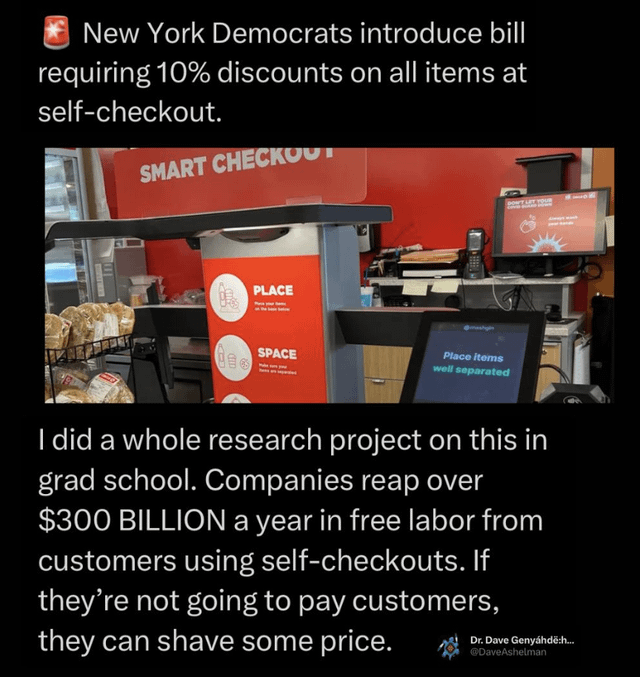
Doesn’t seem that easy to work around. A checkout is either self checkout or it isn’t. Write the law to define a self checkout as “a check out where the majority of items are scanned by a customer rather than an employee.”
That’s because you don’t have the mindset of a sleazy corporate lawyer who is paid $500,000 a year.
Try this: Raise all the prices by 10 per cent. Give the 10 per cent discount to self-checkout customers, as required by law. Pocket the extra for people who are stupid enough to use the self-checkout. Don’t forget to give a middle finger to your local elderly people or disabled people. They’ll now pay extra for the privilege of shopping.
You do realize that the prices in the store right now are already the maximum the stores can charge, do you not?
Corporations are soulless and greedy. They don’t set their prices by buying from a supplier and increasing them by a fixed percentage. There is no point where a company will go, “well, we could charge more and still have the product sell, but that would be improper.” They already set their prices to the maximum the market will bear. They cannot raise prices further without a net loss of income. They set their prices for the maximum product sales cost and quantity sold.
And why can’t the elderly or disabled use self-checkout? If you’re capable enough to walk through a store and grab items from shelves, you’re capable enough to slide them past a scanner. If they’re shopping with a caretaker, then the caretaker can run the check-out instead. The level of dexterity required to use a self-checkout is the same as needed to grab items from shelves, inspect and bag produce, etc. Sure, some people are too disabled to use a self-checkout, but those folks are also too disabled to shop for themselves at all. That was literally how these systems were designed. The companies didn’t want to have to deal with scores of people who were dexterous enough to shop, but not dexterous enough to run the self-checkout.
What do you mean maximum? There’s no cap, as we’ve seen from the way prices have already been rising.
Why doesn’t your grocery store charge $20 for a gallon of milk then if they can just raise prices as much as they want? Have you never even heard of supply and demand?
Let me spell this out for you.
Discount on self-checkout passes.
Stores raise prices so that the price after the discount is the same as it was before.
Consumers continue to pay the prices they’ve been paying.
‘Discount’ evaporates into the aether.
the thing that you may not be considering here is the increased competition from the new city-run grocery stores that are also being proposed will somewhat limit the traditional store’s pricing power since presumably the city stores only need to break even, not turn a profit, and the city stores might not need to pay some set of taxes. we’ll have to see if this actually plays out, but that’s the proposal.
my guess is that large manufacturers like proctor & gamble may not want to supply the city stores, so they may be stocked with lesser known brands, at least at first.
The market doesn’t see the price hike. You pay $100 today, before I hike the prices. I hike the prices to $111.11, but my shelf labels show you the “discounted” price of $100. You keep paying the $100 price that the market currently bears.
That point was completely irrelevant. If someone can’t use the self checkout, ADA compliance requires accommodation, and the business can’t charge them extra. They get the same discounted price as the self-checkout. So, they put a handicap placard on the cashier stand, train the cashier not to ask any questions about disabilities, and give the same “discount” to anyone who uses the register.
4.90
Includes self-checkout discount. Price without self-checkout discount: 5.44
I don’t think this addresses anything I said. Market constraints prevent them from raising prices, not math. I perfectly understand the math you’re describing. You’re failing to understand the economics.
I’m saying the economics don’t matter because you can trick people into thinking prices haven’t gone up.
For ADA compliance purposes, the human cashiers have to give disabled customers the same rate as the self checkout. If I’m running a store, all my staffed checkouts will have handicapped placards, and cashiers will be trained not to inquire as to disability status, but merely “accommodate” everyone in line.
Now everyone is getting the “discount”.
The Amazon Fresh technology is already a loophole to that.
And why do you figure you can’t write a law to accommodate that as well? Some of you guys are looking for so many nits to pick that you think it would be impossible to ever write a law regulating anything whatsoever.
I’m pretty well read in economics. This is a well known concept called unintended consequences. People who are familiar know that there are endless ways to game any system and we tend to prefer very simple rules.