

- cross-posted to:
- news@lemmy.world
- politics@lemmy.world
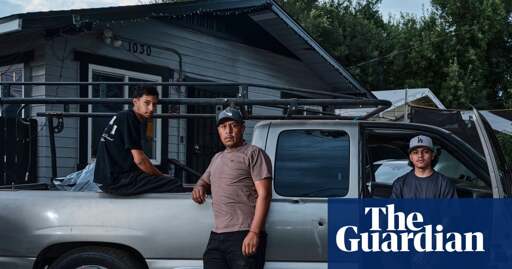
It was just after 8am on 16 August and Francisco Longoria, who runs a party supply business, was driving his truck down a suburban southern California street to deliver a jumper for a water slide. But this ordinary Saturday morning turned into a nightmare when, suddenly, three unmarked vehicles stopped his truck and four masked men jumped out.
Longoria, who had brought his son Jonathan Longoria and son-in-law Daniel Rascon with him, wondered if they were being abducted.
“I see what happens in Mexico,” he said in Spanish. “I thought, are we going to be kidnapped by these masked men?”
The masked men were agents with US immigration and Customs Enforcement (ICE) and US Customs and Border Protection (CBP). They wore police gear, but Longoria said they didn’t identify themselves. As the agents walked toward the truck with their guns drawn, the passengers pulled out their phones to record video.
One agent pulled on the door handle, knocked on the window, and told Longoria to roll down his window, but the agent didn’t have a warrant. When Longoria didn’t comply, the agent smashed the glass and struck him in the face. Another agent broke the front passenger’s window.
With the agents on either side of the truck, and the road ahead clear, Longoria hit the gas. As he drove away, an agent shot three rounds, leaving two bullet holes in the passenger’s side of the truck. One bullet barely missed the back window. Sitting in the back seat, Rascon felt terrified. “One of us is about to get killed,” he thought.
“I was afraid for my life,” Longoria said. “I felt like death was imminent.”
The whole encounter lasted less than a minute, but it was only the beginning of the family’s harrowing tale.
The shooting happened a few blocks away from their home in San Bernardino, about 60 miles east of Los Angeles. When they arrived back at home minutes later, they called the police to report that masked men had shot at them.
Instead of receiving help, Longoria found himself in the crosshairs of a US government investigation that culminated in a night-time ambush of the family’s home, a felony charge accusing Longoria of weaponizing his vehicle against officers, and months in ICE detention – only for the case against him to eventually be dropped.
…
Longoria’s experience is not an isolated one. Since Trump took office last year, ICE has opened fire on at least 30 people, according to Trace, a US outlet tracking such shootings. However, after its agents act violently, the US Department of Homeland Security (DHS), which oversees ICE and CBP, frequently accuses the victims of weaponizing their vehicles against officers. In many cases, such charges end up being dismissed.
This month, ICE agents shot and killed two men in their vehicles in Texas and Maine. Following the shootings, ICE paused most vehicle stops – a move swiftly reversed by Trump.
…
Local police arrived at Longoria’s home and arrested him. “They handcuffed me and put me in the car,” he said. They asked him if he ran over anyone with his truck, and he said no. His family members showed them the videos they had recorded.
While Longoria was in the squad car, the masked federal agents who had stopped the truck arrived at the family home. Local police looked up Longoria’s criminal record, but he didn’t have one. They had no reason to hold him.
But after local police released Longoria, ICE and Homeland Security Investigations (HSI) agents attempted to arrest him themselves, telling family members to open the metal gate to their front yard. The agents lacked a warrant, so the family refused.
On the typically quiet street, neighbors noticed the heavy police presence. They poured out of their homes to defend Longoria and his family, who were known in the community for their contributions to the local church and party business.
The standoff between the crowd and police lasted several hours. Police call logs described the crowd as “hostile”. Officers deployed pepper spray and arrested several people.
Longoria said it felt good to see the community support: “I am forever indebted to them.”
When the officers left, the family felt relieved, but still on edge. They struggled to sleep for weeks after. Rascon noticed vehicles parked nearby that he believed were watching their home. Longoria stayed inside while family members, who are US citizens, picked up groceries and went to work. “We were still looking over our shoulders,” Rascon said.
It turned out their fears were justified. On 28 August, a security camera captured the moment at 4.19am when a group of federal officers in helmets, vests and night-vision goggles arrived while the family were still asleep, pointing guns at their door. They announced over a megaphone that they had a warrant for Longoria’s arrest.
Rascon was asleep on the couch when his mother-in-law shook him awake. He stood up and saw the agents outside carrying assault rifles. The family gathered in the living room, wearing the clothes they had been sleeping in, and called their lawyers.
The officers broke the locks on the exterior metal door and interior wooden door, and pointed assault rifles at them, the lasers from the guns hitting their bodies. Longoria said the agents told them: “If you move, we will shoot you.”
The lasers touched Joana Longoria, Rascon’s fiance, who was five months pregnant. Rascon told the officers: “Don’t shoot, she’s pregnant!”
“I was afraid of having a miscarriage [as a result of the stress],” she said.
…
The agents handed them a piece of paper that alleged Longoria had run over two officers with his vehicle, amounting to a felony charge of assault against federal officers with a dangerous weapon. The family’s lawyers confirmed over the phone that the warrant was legitimate, and they reluctantly allowed the agents to take Longoria. He wore only a muscle shirt and shorts, so they ran to get his clothes as the agents barked at them to hurry up. “I had to leave with my shoes in my hands,” Longoria said.
…
During the hearing, the US attorney acknowledged he couldn’t think of a lawful basis for the officers to stop Longoria’s truck, and he wasn’t aware of any injuries to the officers. The judge said the videos recorded inside the truck were “quite scary”, and granted Longoria bond. But he was still subject to an ICE detainer, a request to hold a person so the agency can assume custody, because the government charged Longoria with being in the US without authorization.
The judge allowed him to hug his children before ICE took him. A few days later, he arrived at the Adelanto ICE facility, a massive 2,000-person capacity detention center in southern California’s high desert.
The food was awful, the portions were too small, and they weren’t given enough water, Longoria said. He estimated he lost 20lbs. The guards watched them constantly, even when they used the bathroom.
…
People who had been injured by federal agents showed him their broken hands and limbs, and he said they did not receive medical attention. At least two people died in Adelanto while he was there – Gabriel Garcia-Aviles, 56, and Ismael Ayala-Uribe, 39 – after ICE allegedly neglected their medical needs.
The government dropped the charges against Longoria on 17 September, but he was still held at Adelanto for a total of three months. After his lawyers fought for his release, Longoria returned home in early December – in time to celebrate Christmas and attend the birth of his granddaughter in January.
In February, Rascon testified before a House and Senate hearing examining violent abuses by DHS agents. “They’re terrorizing more than just our neighborhood … They haven’t stopped, to this day,” Rascon told the Guardian. He wants to see the officers face justice: “They should be imprisoned or charged.”
The lawsuit alleges officers attempted to “cover up” the truth of the shooting by making false statements that led Francisco to be charged – “part of a wide-ranging pattern of behavior … where ICE and/or CBP officers shoot or otherwise attack innocent people and then manufacture charges … falsely alleging the innocent individual ‘weaponized’ their vehicle, only to later dismiss all charges”.