

- cross-posted to:
- linux_gaming@lemmy.world
- pcgaming@lemmy.ca
- cross-posted to:
- linux_gaming@lemmy.world
- pcgaming@lemmy.ca
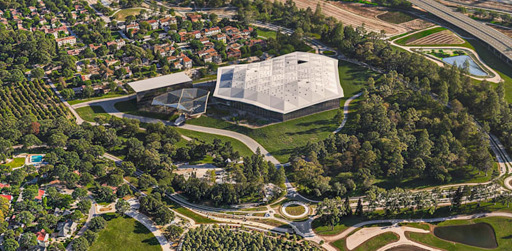
Nvidia has confirmed “Globes” report that it has chosen the Israel Land Authority (ILA) area in Kiryat Tivon to build its huge campus that will accommodate up to 10,000 employees.
According to the illustration published by the US chip giant, this will be a large campus inspired by the design of the company’s new iconic headquarters in Santa Clara. When built it will be surrounded by commercial areas and restaurants with investment in parks and green spaces.
There’s no US tech without Israel.
Intel also has a large Israel presence and they have had backdoors in their hardware before, though claim it was not on purpose. Interestingly, the vulnerabilities in the AMD equivalent were reported by an Israeli company. Perhaps AMD crossed them and this was vengeance, or perhaps this was completely independent of any Mossad agenda.
Qualcomm also has a history of working with Israeli companies on R&D, as well as acquiring some of them.
And if you thought “hey, maybe Apple, the only real competitor in the CPU space after the aforementioned, has no Israeli ties beyond just selling them products like everyone else”, well unfortunately Apple also has an Israel office.
Guess what, ARM itself has Israel ties so you can’t TRULY escape Israeli influence.
Short of RISC-V taking off, there’s no computing without Israel being involved in one way or another.
Israel is also behind some of everyone’s favourite apps, such as Waze, formerly known as FreeMap Israel.
Google has two offices in Israel, Microsoft straight up provides them military surveillance solutions and has a huge R&D office… And Oracle’s CEO literally vetted potential US presidential candidates for Israel.
It’s not just American tech companies either. If you do want to make your own chips, you’d probably use TSMC, which has strategic ties with Israel. ASML, the company that provides TSMC with the ultra high tech EUV machines also has an Israel office, though it’s not like you can make a backdoor with EUV tech… I think. But basically if you have a computing device of any sort, Israel has profited from it in some super minor way, even if it’s just 0.0001%.
TL;DR: If you use any major piece of software OR hardware that’s not open source, Israel’s probably had their grubby fingers in it.
Thanks for putting this together.
Yes. I wouldn’t focus too much on someone being able to tell which map you’re playing, and which color your car has in Need For Speed. It’s way more unsettling what’s in networking equipment. Or inside an Intel Management Engine, and the firmware blobs of all the computer chips. Or the software running on it.
just wait until you know what your graphics card could actually do. live OCR on screen contents, face detection and training on anything ever displayed on the screen.
unless I miss something then also direct access to all system memory (when SR-IOV is disabled, or has been set up improperly), write access to onboard firmware, probably access to your drives and network too.
same applies to any pci express device you put into your machine.
Sure. I’m not entirely sure how PCIE works these days. But in it good old days we had methods to read pretty much arbitrary memory regions via PCIE or early Thunderbolt(?).
I just figured it’d be massively complicated to wait for the user to pull something on the screen, do computationally expensive OCR, some AI image detection to puzzle documents back together, and then you’d only get a fraction of what’s really stored on the computer and you’d still need a way to send that information home… When you could just pick a plethora of easy options like read all the files from the harddisk and send just them somewhere. I think it’s far more likely they do some easy and straightforward solution. And it’d be more effective as well.
I think that’s easier to do for GPUs than CPUs, and they could do it nonstop with say a 5 fps rate.
but also now that I think of it more, the graphics card doesn’t really need to do all this, the manufacturer given binary blob kernel driver has easier access to disk and network
Demonization of China focusing more clearly every day
What an endless nightmare
I remember on a Meets call with my Israeli coworkers and they had to go to the bomb shelter because of rockets.