

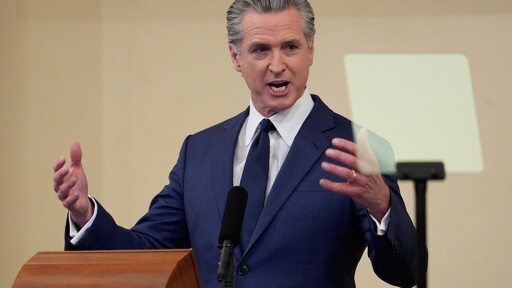
LOS ANGELES (AP) — A proposed billionaires’ tax in California has ignited a political uproar in Silicon Valley, with tech titans threatening to leave the state while Democratic Gov. Gavin Newsom maneuvers to defeat a levy that he fears will lead to an exodus of wealth.
A technology mecca, California has more billionaires than any other state — a few hundred, by some estimates. Nearly half its personal income tax revenue, a financial backbone in the nearly $350 billion budget, comes from the top 1% of earners.
A large health care union is attempting to place a proposal before voters in November that would impose a one-time 5% tax on the assets of billionaires — including stocks, art, businesses, collectibles and intellectual property — to backfill federal funding cuts to health services for lower-income people that were signed by President Donald Trump last year.
In a state with a vast gap between rich and poor, the plan has resulted in a tangle of competing interests at a time when both Democrats and Republicans are struggling to respond to economic anxiety driven by rising costs ahead of this year’s midterm elections.
So “nearly half” of California’s income tax revenue comes from the top 1% of earners, and “a few hundred” billionaires would be subject to this one-time tax.
There are approximately 20 million workers in California, so the top 1% of earners is about 200,000 people.
Even with a high end estimate, roughly 195,500 of the top 1% of earners will not be subject to this one-time tax. This bill only targets the top 0.0025% of earners in California. One four-hundredth of the top one percent.
Top 1% is just under a million a year, sounds like a lot but that’s doable for top tier software engineer. Those people aren’t going anywhere unless the companies themselves move.
It’s still the easiest place to find and run a start up so most wouldn’t necessarily leave.