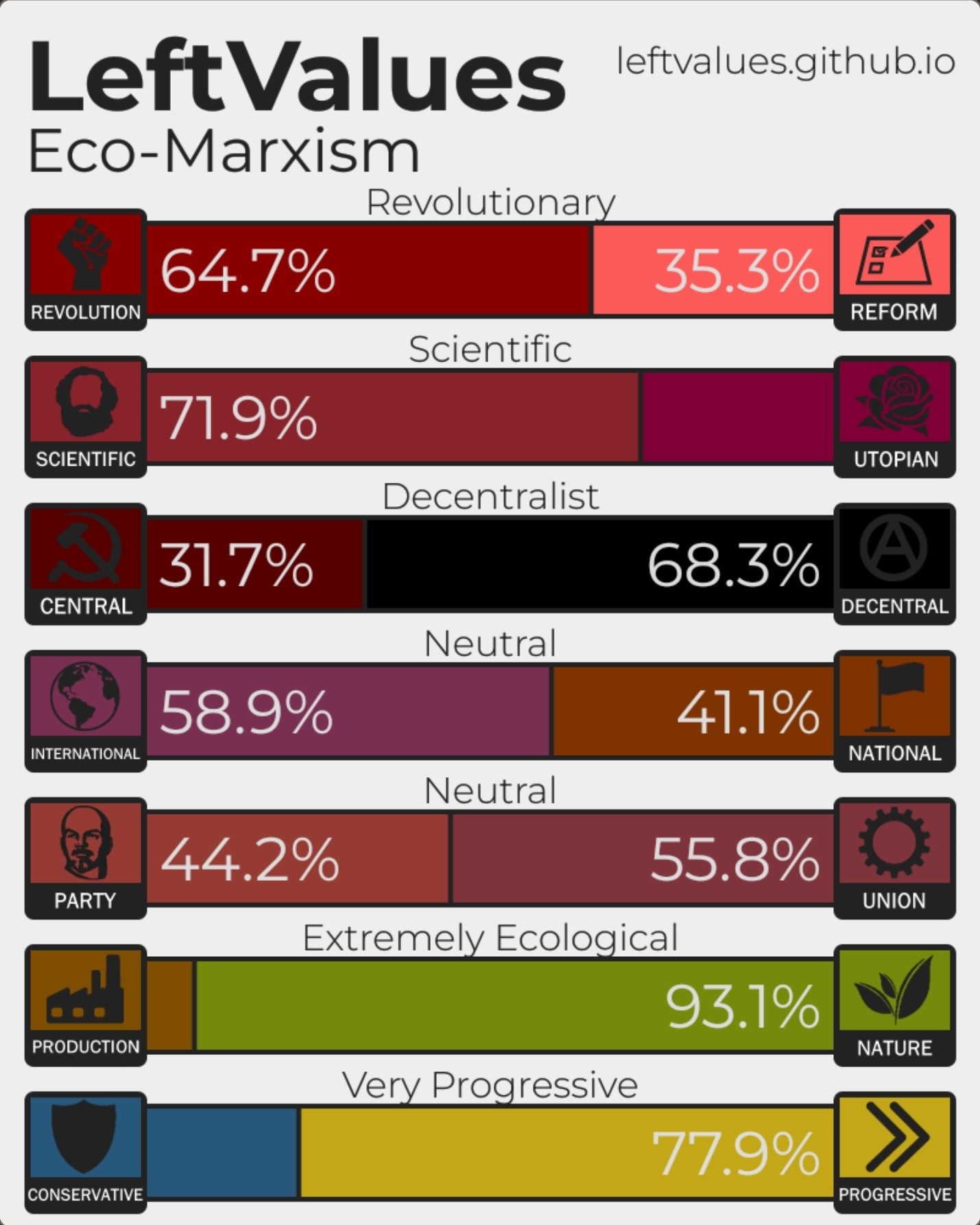
where do you stand on the socialist spectrum? i’ll start: my socialist views are a fusion of market socialism, welfarism, georgism and left-libertarianism - i took the leftvalues quiz (as shown in the photo attached in this post), and i got “centrist marxism”. you DON’T have to take the quiz though.

EDIT: i just added the link

  • Aeri@lemmy.world
    link
    fedilink
    arrow-up
    2
    ·
    10 hours ago

    It’s a tricky quiz because my answers to a lot of these questions aren’t simple enough. This quiz makes sparks when you bump it against nuance. I’ll just highlight a few of these, a lot of them didn’t sit well with me. A lot of these questions feel like they’re “baiting” you for a specific view you don’t actually hold. Several questions on the quiz strike me as abstract and half-baked. Honestly screw this test tbh… Too much “Only”, too much “Must”, this quiz deals in ludicrous absolutes.

    “Some small scale destruction of nature is acceptable if it notably benefits humanity.”

    This question, it is a nothingburger, it’s too vague to have any value to the test whatsoever. It could mean literally anything depending on how its framed. Cutting down a hedge that spoils my view is a “small scale destruction of nature”. The same argument could be used to justify building a Walmart over a protected wetland. This question compresses trivial gardening and corporate ecological devastation into the same moral bucket. My REAL answer, in real ethics language, is:

    “Sometimes limited ecological modification may be necessary but the framing ‘acceptable if it benefits humanity’ is dangerous, underspecified, and historically abused.”

    “Foreign officials have no right to dictate policy in another country.”?

    I reject foreign control over domestic policy, but support external pressure when human rights are violated. Where does that put me? Neutral would understate my conviction, strongly agree implies that foreign officials should NEVER influence another country. Disagree would imply support for dominance, coercive intervention, or global governance overriding nations

    “Socialist organizations are generally better off when organized loosely and decentrally.”

    Loose & decentralized organizations protect values better, but tight & centralized organizations win fights better. There are tradeoffs.

    “Revolutionary violence is acceptable as long as the final outcome is positive.”

    This is a toughie, the problem is this part: “…as long as the final outcome is positive”. The problem is that this assumes three things that do not exist in reality:

    1. Completely reliable foresight

    2. Objective agreement on “positive”

    3. Controlled causality between violence and outcome

    History shows that everyone who commits political violence believes the outcome will be positive. Many of the most catastrophic regimes in history have justified their violence with “The final outcome will be good.”. I feel this question is a trick, my key issue is that I believe the question is not asking:

    “Is violence ever justified under extreme circumstances?”

    It is asking something much more dangerous and much broader:

    “Is revolutionary violence acceptable as long as someone believes the final outcome will be positive?” This is blank-check consequentialism which could be used to justify Mass violence, Terror campaigns, Political purges, Civilian casualties and Authoritarian crackdowns to name a few. I hit disagree on this because I will explicitly state that sometimes violence may be tragically necessary, but it is never automatically justified by promised futures or ideological certainty. This rules out “Strongly Disagree” but I also don’t necessarily agree either.

    “Mass spontaneous actions are more effective than carefully planned actions.”

    I reject the forced comparison. Treating this as an either/or is bad systems thinking. Spontaneous mass action and careful planning are complementary, not competitors.

    “Nationalism and patriotism are impulses that are unacceptable in a socialist society.”

    This lumps things that are NOT THE SAME together. I reject the idea that all nationalism and patriotism is inherently unacceptable in a socialist society. Blind flag-worship and authoritarian nationalism are toxic, but a critical, value-based patriotism rooted in equality, equity, liberty, and holding a nation accountable to its own best ideals is not only acceptable, it’s often necessary for meaningful change. Loving a country enough to challenge its failures is not the same as excusing its power.

    Revolution is the best way of achieving a socialist society.

    Three huge problems:

    “Revolution” is undefined. Do you mean:

    Violent uprising? Mass general strike? Electoral rupture? Legal-constitutional overthrow? Elite collapse under pressure?

    These are not the same thing at all.

    “Measures to address environmental issues are unacceptable if they result in significant decreases in production and quality of life.”

    This question is built on fear-framing and absolutism.!

    Here are my test results:

    Reformist (60.3%) vs Revolutionary (39.7%)

    This is Accurate, but for the wrong reasons. I believe this test badly compresses reality.

    This one is numerically close, but it misunderstands why. I’m not anti-revolution because I think the system will gently fix itself if we ask nicely. I don’t believe that for a second. I’m skeptical of revolution as a romantic default because history shows over and over that violent rupture is just as likely to midwife a new tyranny as a just society. What I actually believe in is coercive reform via strikes, mass disruption, taxation, seizure through statute, regulatory clamps, and public force that is structural rather than chaotic. This axis treats “revolution” as passion and “reform” as politeness, which is just inaccurate. I don’t want polite. I want effective without becoming monstrous.

    Scientific (57.8%) vs Utopian (42.2%)

    Accurate

    I don’t believe in destiny narratives or historical inevitability. I believe in thermodynamics, logistics, climate models, infrastructure bottlenecks, and failure modes. I don’t think history has a moral arc that saves us by default. If anything, systems rot quietly when they aren’t constrained. My politics are grounded in constraint, not prophecy. I care about what works under pressure, not what sounds righteous on a poster. So many of these damn questions are “ALWAYS” this and “MUST” that.

    Decentralist (65%) vs Centralist (35%)

    Basically correct. I deeply distrust monoculture power; single spines of authority, single ideologies, single parties, single command centers. They’re fragile, corruptible, and catastrophic when they fail. At the same time, I’m not an anarchist who thinks we can coordinate climate engineering and continental power grids with vibes and community meetings alone. I believe in layered systems: local where possible, centralized where necessary, never unified where it becomes unaccountable.

    International (57.1%) vs National (42.9%)

    This one is technically right and emotionally wrong. I reject ethno-nationalism and imperial supremacy completely. I also believe planetary ecological coordination is non-negotiable. But I don’t believe belonging, culture, and civic identity should be erased in the name of abstract globalism. I believe in international responsibility and local moral inheritance at the same time. The test treats those as opposites. They’re not.

    Party (53.8%) vs Union (46.2%)

    This one reads me as “torn,” which is true only if you assume purity is the goal. I don’t trust any single institution to carry the entire weight of social transformation. Parties drift. Unions fracture. Movements exhaust themselves. Dipshits who are part of a union voted for Trump even though he makes actively destructive choices for their way of life at every turn. This test can’t distinguish strategic pluralism from indecision.

    Ecological (72.2%) vs Productivist (27.8%)

    If anything, this undershoots me. I don’t treat the biosphere as one interest among many. It’s the substrate everything else runs on. Production that destroys the future is a high crime. We need to safeguard our habitable biosphere at any and all costs. I accept that output may fall. I accept that comfort may shrink. Infinite growth is not sustainable in any natural system.

    Progressive (85.3%) vs Conservative (14.7%)

    This one is obvious and almost too easy to include. Equity, minority protections, gender freedom, movement across borders, disability access, and dismantling inherited hierarchy aren’t “trendy politics” to me—they’re baseline justice in a world that can absolutely afford it even if it pretends it doesn’t.

    Overall, the label “Democratic Socialism” is not wrong, but it is far too small for what I actually believe. Structurally, this test has a deep problem: it constantly confuses values with mechanisms and mechanisms with outcomes. It uses a constant barrage of absolutist language “must”, “only”, “always”, “inevitable” as if the whole of human history were a simple logic puzzle. It treats ideology like a form of astrology instead of something that has to survive contact with physics, ecology, corruption, human fear, greed, and institutional decay. It cannot represent someone who believes in equality of dignity, equity of outcome, coercion through law rather than violence, decentralization without fragmentation, and global coordination without global absolutism.

    And don’t get me wrong, I fucking LOVE a good violent fantasy game/movie/etc, it’s just rare that such a thing actually goes super well in reality.

    But yeah here’s my god damn “Here’s my facebook personality quiz results :o!” Sorry, this made me weirdly super mad for some reason I’m off my meds today.

    • DylanMc6 [any, any]@lemmy.mlOP
      link
      fedilink
      English
      arrow-up
      1
      ·
      5 hours ago

      i had to take that leftvalues quiz again for this comment:

      Q: Some small scale destruction of nature is acceptable if it notably benefits humanity.

      A: don’t destroy nature, please - disagree.

      Q: Foreign officials have no right to dictate policy in another country.

      A: i think they should - strongly disagree.

      Q: ‘Socialist organizations are generally better off when organized loosely and decentrally.’

      A: maybe, maybe not - neutral/unsure.

      Q: Revolutionary violence is acceptable as long as the final outcome is positive.

      A: i think government reforms should be necessary for the switch to socialism, but if the government tries to suppress it, we might as well reluctantly use force in a revolution - neutral/unsure.

      Q: Mass spontaneous actions are more effective than carefully planned actions.

      A: i think actions should be planned - neutral/unsure.

      Q: Nationalism and patriotism are impulses that are unacceptable in a socialist society.”

      A: you can be socialist AND support your country - neutral/unsure

      Q: Revolution is the best way of achieving a socialist society.

      A: …if the government tries to suppresses socialist reforms - agree.

      Q: Measures to address environmental issues are unacceptable if they result in significant decreases in production and quality of life.

      A: no comment - neutral/unsure.


      here are my results - still got ‘centrist marxism’:

      basically:

      revolution vs. reform: NOT anti-revolution, but i support reform (with revolution being an option for when the government suppresses socialist reforms) - leaning towards reformism. shoutout to eduard bernstein.

      scientific or utopian?: scientific, probably

      central vs. decentral: who cares? everyone just want a say in the government

      international or national: very internationalist

      party or union?: still both!

      production or nature: leaning towards ecology

      progressive or conservative: progressive


      oh and what meds were you taking, and is there any reason why?

  • HiddenLayer555@lemmy.ml
    link
    fedilink
    English
    arrow-up
    4
    ·
    edit-2
    2 days ago

    A lot of those are open ended questions being forced into a 1 dimensional spectrum of agree or disagree, and/or have weakly defined terms whose meaning are not consistent between individuals.

    I wanted to provide just a few examples but got carried away, so here’s every question I personally found some problem with:

    Society is chiefly driven by individuals and ideas.

    Define “chiefly driven.” I could argue that it is by definition because society is made up of individuals so that’s the only driving force, like how ocean currents are the convergent result of molecular interactions because that’s what the ocean is made of. But I suspect they’re trying to get at the idea that convergent actions of groups of individuals can’t be accurately modeled by studying the behavior of an individual in isolation. Both are valid IMO.

    Bureaucracy and inefficiency are always inherent in centrally planned economies.

    What does it mean to be bureaucratic or inefficient?

    Marriage is a patriarchal social construct that should be phased out.

    It’s fine to have marriage if that’s what both consenting adults want, but it shouldn’t be the only option. On the other hand, things like common law partner legislation can get messy when it automatically applies to people living together that fulfill some arbitrary criteria, regardless of whether they actually intend to be partners. An alternative thought is that romance and reproduction between consenting adults should be a purely social phenomenon, not a legal one, and the government should not get involved whatsoever.

    Industrialized farming practices must be abolished even if it leads to lower outputs.

    Depends on what you’re farming and which industrial process you’re using. Something like a vertical hydroponics facility should be treated differently from spraying synthetic fertilizer and pesticides on fields should be treated differently from factory animal farming, etc. “Industrialized farming practices” is too general for a single agree/disagree answer.

    Local planners, rather than national planners, are more efficient at running a planned economy.

    I don’t know of any socialist or capitalist country that only has one and not both.

    Prisons are oppressive and antiquated institutions that need to be abolished.

    Define “prison.” You can assume it’s like a Soviet gulag, or a Western prison, or something else, and your assumption influences your answer because you likely have different opinions of them.

    It is acceptable for humanity to suffer to some notable extent in order to preserve the natural ecosystem.

    Define “suffer.” Are we culling overpopulated regions? Are we denying Indigenous groups their cultural practices such as whaling or seal hunting? Are we limiting recreation like camping and hiking for the sake of ecological protection? How you interpret suffering significantly influences your answer.

    A highly centralized planned economy is not socialism but rather state capitalism.

    Depends on how it’s implemented and what it’s inspired by, and it’s not a binary “socialism” or “state capitalism.” Just saying “centralized planned economy” with no further context is insufficient to make a decision.

    A centrally planned economy based around computers is a concept worth investigating.

    Again, computers or no computers is not the important part here. What are the actual policies and structure of the economy in question? I doubt there are any economies today, socialist or capitalist, that doesn’t use computers.

    The negative consequences of a revolution generally outweigh the advantages.

    There’s no way to generalize negative or positive societal consequences without clarifying what types you’re referring to. What specific ones are we talking about? A revolution impacts every single facet of society and vague questions like these are not helpful. It’s like asking if a mainframe is objectively “better” than a smartphone, you can’t reduce it to a single answer and it depends on your priorities.

    Socialist organizations are generally better off when organized loosely and decentrally.

    Define “better off.” There are advantages and disadvantages to both decentralization and centralization.

    Any socialist country should be dedicated to exporting their ideology abroad.

    Define “export abroad.” Are we printing pamphlets and mailing them over or are we going full America and doing regime changes on countries we disagree with? Your interpretation will determine your answer more than your actual opinions on any given form of ideological export.

    Measures to address environmental issues are unacceptable if they result in significant decreases in production and quality of life.

    What kinds of production? What aspects of quality of life? To what kinds of people? For how long? Are we reducing just the quality of life of people already with the highest quality of life down to some middle level while bringing everyone lower than that level up to it? Or are we flat rate dropping everyone’s quality of life by some amount, meaning the people already most disadvantaged will be disproportionately affected? There’s a difference between preventing a developing country from obtaining advancements that the developed world has, and banning cars meaning you have to use public transit or banning plastic meaning you have to use less convenient/durable organic polymers.

    Some small scale destruction of nature is acceptable if it notably benefits humanity.

    Again, define “destruction of nature.” Nature isn’t the opposite to human built environment. We and everything we do are part of nature by definition so it as a label is unhelpful for determining if some action is ecologically beneficial or detrimental or whether we “should” do it. Also, this question honestly gives me the vibe that the author thinks densifying a suburb of single family houses into a vertical city is “destruction of nature” simply because there’s less green per square meter.

    Anyway, I tried my best to answer truthfully and apparently I’m an Eco-Marxist.

    You know what, pretty accurate. I seriously “got into” socialism during my time in university studying ecology.

    • Cowbee [he/they]@lemmy.ml
      link
      fedilink
      arrow-up
      3
      ·
      1 day ago

      I agree that the quiz is bad, just wanted to add that the bit on society being driven by individuals and ideas is asking if you’re an idealist or a materialist. Marxists posit that it’s material conditions that drive those ideas and movements in society. “It is not consciousness of men that determines their being, but, on the contrary, their social being that determines their consciousness.”

      As for being an Eco-Marxist, the quiz is guessing what you are, it isn’t telling you what you are. It says that for me too, but I’m a Marxist-Leninist. People don’t typically answer quizzes based on their current ideas and see what they should also agree with, people’s politics are their own choices to support and follow.

    • DylanMc6 [any, any]@lemmy.mlOP
      link
      fedilink
      English
      arrow-up
      1
      ·
      edit-2
      2 days ago

      okay, i just had to do that leftvalues quiz again, i’ll talk about what i think about the questions you listed (in no fixed order):

      Q: ‘Local planners, rather than national planners, are more efficient at running a planned economy.’

      A: i prefer national planners - neutral/unsure.

      Q: ‘It is acceptable for humanity to suffer to some notable extent in order to preserve the natural ecosystem.’

      A: maybe, maybe not - for the most part, we should work together to help our environment - neutral/unsure.

      Q: ‘Society is chiefly driven by individuals and ideas.’

      A: fascism is NOT even an idea, but a very violent individualist ideology that resulted in the mass murder of millions of people in the Holocaust, one of the most tragic events that has ever happened in history. that said, society is actually driven by collective work - neutral/unsure.

      Q: ‘The negative consequences of a revolution generally outweigh the advantages.’

      A: after the october revolution, russia did recover under socialism and such - neutral/unsure.

      Q: ‘Any socialist country should be dedicated to exporting their ideology abroad.’

      A: amen to that - strongly agree.

      Q: ‘Industrialized farming practices must be abolished even if it leads to lower outputs.’

      A: farming is an important part of a socialist society, as long as it’s NOT industrialized completely - neutral/unsure.

      Q: ‘A highly centralized planned economy is not socialism but rather state capitalism.’

      A: some people considered china and vietnam among other socialist/communist countries to be ‘state capitalist’, me included. i think china’s economy is technically state capitalist because much of the economy goes to the state through state-owned enterprise - agree.

      Q: ‘Bureaucracy and inefficiency are always inherent in centrally planned economies.’

      A: maybe a participatory economic system, perhaps? agree.

      Q: ‘Socialist organizations are generally better off when organized loosely and decentrally.’

      A: some should be decentralized, some should not - agree.

      Q: ‘A centrally planned economy based around computers is a concept worth investigating.’

      A: chile’s cybersyn comes to mind - strongly agree.

      Q: Marriage is a patriarchal social construct that should be phased out.

      A: marry who you want, as long as you’re both consenting adults - neutral/unsure.

      Q: Prisons are oppressive and antiquated institutions that need to be abolished.

      A: prisons should be for rehabiliative justice - neutral/unsure.

      Q: Measures to address environmental issues are unacceptable if they result in significant decreases in production and quality of life.

      A: no comment - neutral/unsure.

      Q: Some small scale destruction of nature is acceptable if it notably benefits humanity.

      A: no comment - neutral/unsure.


      still got “centrist marxism”.

      revolution vs. reform: very conflicted - i think socialism starts at the ballot, but if NOT the ballot, then we all must reluctantly use force.

      scientific or utopian?: sort of a cross.

      central or decentral: who cares if it’s decentralized or NOT? everyone should have their own say in a socialist government.

      international or national: international revolutions are the way to go.

      party or union?: both!

      production or nature: protecting our environment should be an essential step to a socialist country.

      conservative or progressive: progressive. seriously!

  • Narri N. (they/them)@lemmy.ml
    link
    fedilink
    arrow-up
    3
    ·
    2 days ago

    I’ve never even heard of “council communism” tbh, but then again I’m only just learning about all this. Looking up the meaning and stuff for “democratic centralism” made me realize how little I actually know, but in a positive way if that makes sense?

    • Cowbee [he/they]@lemmy.ml
      link
      fedilink
      arrow-up
      3
      ·
      1 day ago

      Council Communism was a small movement centered around councils (go figure). Democratic centralism is typically described as diversity in thought, unity in action, ie consensus is built and voted on, and the results are binding on all members. If you want a place to start with theory, I made a Marxist-Leninist reading list. Check it out if you like!

      • Narri N. (they/them)@lemmy.ml
        link
        fedilink
        arrow-up
        2
        ·
        19 hours ago

        I know you did, I’ve actually shared it forward with some friends irl recently! Yeah I needed to go and look up these meanings for the quiz, which is something I generally like to do and often end of going down rabbitholes on wikis so no harm in that.

  • lemonwood@lemmy.ml
    link
    fedilink
    arrow-up
    2
    ·
    2 days ago

    I got Eco-Marxism and I like, that the quiz prominently features questions on the environmental crisis. But I feel like, there is not much on reproductive labor or on how imperialism and racism should be addressed. These areas of struggle are every bit as central and contested as the environment. The quiz is leaning towards a white, western, cis-male perspective, but it should be possible to add a few questions and categories to address that. Maybe inspired by Marxist Feminism, Black Marxism, Afro-Marxist traditions, decolonial struggle and anti-imperialist praxis.

    • DylanMc6 [any, any]@lemmy.mlOP
      link
      fedilink
      arrow-up
      1
      ·
      2 days ago

      do you think that socialism (like marxism-leninism and the likes) failed to address racism and environmental problems (because that’s the point of “socialism of the 21st century”)?

  • Vupware@lemmy.zip
    link
    fedilink
    arrow-up
    11
    ·
    3 days ago

    For some of these questions, I felt I lacked a sufficient understanding to provide a confident answer. That led to more neutral/unsure answers than I would have preferred.

  • Cowbee [he/they]@lemmy.ml
    link
    fedilink
    arrow-up
    23
    arrow-down
    1
    ·
    4 days ago

    I’m a Marxist-Leninist, here are my results.

    This test isn’t to tell you what you are, but instead what the test maker thinks you are. What you are is ultimately up to you. If you or anyone else wants to get started on reading Marxist-Leninist theory, I made an introductory reading list.

    • PolandIsAStateOfMind@lemmy.ml
      link
      fedilink
      arrow-up
      17
      ·
      4 days ago

      This one isn’t too bad for an internet political test, though i would said that eco-marxism is pretty misleading since all the notable ML parties are proecological nowadays and in 1910’s that question was much less pressing.

      I did get ML result so lol.

      • Cowbee [he/they]@lemmy.ml
        link
        fedilink
        arrow-up
        17
        ·
        edit-2
        4 days ago

        Yea, they require you to pick nationalist answers to get ML but the ML stance on nationalism depends on if you’re in the global north or global south, ie does your nationalism work against imperialism or towards perpetuating it. It also requires the person to pick production over ecology.

        • PolandIsAStateOfMind@lemmy.ml
          link
          fedilink
          arrow-up
          7
          ·
          4 days ago

          the ML stance on nationalism depends on if you’re in the global north or global south, ie does your nationalism work against imperialism or towards perpetuating it

          Yeah

          I don’t think any actual MLs can get the ML result lol

          This contradicts the sentence above, just look at AES states. I mean nationalism will always be a crutch for socialist states but its an useful crutch at least as long as imperialists are out there.

          • Cowbee [he/they]@lemmy.ml
            link
            fedilink
            arrow-up
            11
            ·
            4 days ago

            Yes, but the questions are framed in a way that make it seem odd.

            “Nationalism and patriotism are impulses that are unacceptable in socialist society” is phrased in a manner that either means you agree with nationalism within socialism or you don’t, not if they have context. It has nothing to do with your present country, that’s entirely on the user’s interpretation. Someone in the global south and the global north both see the same question the same way, as it doesn’t tie the answer to the north or south. The correct answer is that it’s useful in resisting imperialism and horrible if used to perpetuate it.

            There’s also the fact that it requires you to take a productvist approach over an ecological one, and the way those questions are phrased are bad as well. We should work to increase production in a green manner, not become an anarcho-primitivist, yet the quiz hints like those are the counterposed ideas.

              • Cowbee [he/they]@lemmy.ml
                link
                fedilink
                arrow-up
                9
                ·
                4 days ago

                Agreed, I always got lib left and back in my non-Marxist days I assumed that meant I was more aligned with anarchists. Thankfully reading theory helped me understand more.

  • PM_ME_VINTAGE_30S [he/him]@lemmy.sdf.org
    link
    fedilink
    English
    arrow-up
    7
    ·
    4 days ago

    The quiz nailed the fact that I’m an anarcho-communist. I think my numbers “suffered” a bit because there are questions where I personally hold beliefs about which choices are easiest to implement, but I also believe that a collective of reasonable people could make some other choice and implement it in a liberatory way. In particular, I’m not against planning certain segments of the economy (e.g. electrical power distribution) as long as we do it with the continuous consent of the people and we don’t kill people/collectives who go their own way. Similarly, I’m pretty staunchly anti-markets, but I’m not closed to the idea that reasonable people could live happy lives under genuinely anarchistic market socialism if for some reason a community chooses to continuously consent to that mode of living.

    • BreadstickNinja@lemmy.world
      link
      fedilink
      English
      arrow-up
      4
      ·
      3 days ago

      Yeah, some of them I would give totally different answers if imagining the question as applying to billionaires vs. workers, developed vs. developing countries, today versus a long-term objective, etc.

      In the end it labeled me an eco-anarchist which I’m not mad at.

  • 𝕆𝕔𝕦𝕝𝕚@anarchist.nexus
    link
    fedilink
    English
    arrow-up
    6
    ·
    4 days ago

    Here are mine. I don’t think about (or know?) what ideology i’d adhere to, but i’m not sure it matters much. Imo it’s my views/opinions of the concepts themselves that are important, not a big-tent name of an ideology.

    I am still not comfortable enough with my grasp of marxism/anarchism/etc (still reading theory to understand them all. I’ve been progressing well) to the point i could answer properly to these questions so it’s probably not reflective of my actual views,

    Nonetheless i of course get this is just a fun little online test, nothing serious ¯\_(ツ)_/¯

    image

    • Cowbee [he/they]@lemmy.ml
      link
      fedilink
      arrow-up
      7
      ·
      4 days ago

      Congrats on your studies! Anything stand out to you particularly, whether it’s anarchist or Marxist? As in, particularly useful, enjoyable, etc?

      • 𝕆𝕔𝕦𝕝𝕚@anarchist.nexus
        link
        fedilink
        English
        arrow-up
        6
        ·
        4 days ago

        Thanks!

        I don’t like to tackle more than one subject at once, so currently I’m just focusing on Marxism, which i have unfortunately limited time for, but i still try :) iirc I’ve read/am reading currently:

        • How Marxism Works (Trotskyist pamphlet, but still pretty good even by anti-Trotskyist standards),
        • Principles of Communism (still reading, but easily digestible, thankfully)
        • The Three Sources and Three Component Parts of Marxism

        And thanks to the last text, I think I have a good framework of what i should focus on while studying; i.e.:

        • Dialectic materialism (I’ve grasped the laws, but I’ve yet to learn how to apply it to analysis of the world),
        • Labor theory of value (understood!)
        • Class struggle, which from a first impression, sounds like a basic “no shit Sherlock” concept, but I’m sure it ties back to materialism, and the transition of feudalism -> capitalism -> socialism, though I’ve yet to reach the relevant reads for that.

        I’ve actually been using your reading list as a good starting point (thanks for that, by the way!) so far, I’m only loosely using it to know what I should read next, since i already recognize a ton of the material there anyway, but it is still very useful for it to be organized well. But eventually I’ll probably follow it more strictly for the sake of accuracy.

        After I’m finished with the principles of communism, I’d have completed my current 3 ‘to read’ texts and move on to the next one, which would probably be: What is to be Done, The Wretched of the Earth, and (tediously 🫠) all volumes of Capital.

        Although, an important point now for me is trying to re-understand history/figures. I’ve found it easy to like Marx+Engels/Castro/Ho Chi Minh (and by extension, more fairly analyze Cuba/Vietnam + read their works without a negative bias), since there’s very little hatred towards them in my region/on the online spaces i regular, but a lot of material that most Marxists today consider crucial, I have negative/mixed views towards the authors; but in fairness most of my negative views have been earned years before, and I’m no stranger [now] to how propaganda can reframe even good people into being “scary baby eaters”, so my goal as of now is trying to read on important figures and change my opinions on them, for better or worse. Of course, I’m not saying my views are wrong and I should force them to be positive, but a critical re-analysis of them all would be very useful. If they are bad people, then that’s that, and there’s nothing I could do about it, but otherwise, it would help me a lot in reading their works, and in general, change my world-view.

        Okay, this comment is getting long lol. Thanks again for the reading list :D

        • Cowbee [he/they]@lemmy.ml
          link
          fedilink
          arrow-up
          9
          ·
          edit-2
          3 days ago

          That’s awesome!

          Harman’s How Marxism Works, outside of the weird misogyny and Trotskyist parts, is legitimately a good place to start. It’s clear and concise.

          You’ve nailed the 3 core areas, those being dialectical materialism, the law of value, and class struggle. Dialectical materialism applied to history becomes historical materialism, and broadly ties to class struggle, which you correctly point out as the driving force behind the progression of historical modes of production.

          Class struggle also informs class ideology, ie the petite bourgeoisie tends to go for more individualist ideologies while the proletariat understands the importance of collectivization, because how we live and produce informs how we understand the world. Mao’s On Practice & On Contradiction is probably the single best pair of shorter essays on driving this home and developing it.

          If I may make a suggestion, skip What is to be Done? for now. That’s more of an article talking about strategy, and while useful, isn’t very important for grasping the basis of Marxism. I’d say Imperialism, the Current Highest Stage of Capitalism and The State and Revolution are both more immediately important, but before them I would suggest more than any other single work Socialism: Utopian and Scientific (or better yet, Anti-Dühring). This right here is what will dramatically expand upon and tie together everything you’ve learned thus far.

          Capital can honestly be postponed for quite a while, I consider it critical but quite advanced. Excellent choice with Fanon though, The Wretched of the Earth is a banger.

          As for the figures I’m assuming you’re referring to, I highly recommend Domenico Losurdo’s Stalin: The History and Critique of a Black Legend. Stalin wasn’t a saint, and this book doesn’t make him out to be one, it tries to correctly separate the “black legend” from the man in reality and place him in his correct historical context, using only western, anti-communist sources. Sadly I don’t know of a book of a similar caliber for Mao, but I also find Mao isn’t as heavily demonized as Stalin is. The closest is Nia Frome’s short essay “Tankies.”

          Anna Louise Strong’s works, such as This Soviet World, are excellent ways to expand your knowledge of what the USSR was actually like from someone on the ground reporting on it. Also beloved by me are Michael Parenti’s Blackshirts and Reds and the “Yellow Parenti” speech.

          And thanks for the kind words on the reading guide!

          • 𝕆𝕔𝕦𝕝𝕚@anarchist.nexus
            link
            fedilink
            English
            arrow-up
            5
            ·
            4 days ago

            Good to know my understanding to this point has been correct! And as for dialectics, I’ve been trying to figure out good examples on how to apply it to understand a situation but did not understand how. Based on your comment, are dialectics in Marxism only really used for Historical materialism, or is it used for more applications? If so, then I see I was wrong in trying to understand dialectics without looking at historical materialism 🙃

            And the class struggle explanation makes sense. Just a question, do the labor aristocracy count as petite bourgeoisie, or are they the non capital/land-owning equivalent? That would explain on why more middle class people I meet (even the progressives/leftists sometimes :/) are more likely to support imperialism / liberalism to preserve their own material conditions, at the cost of others. And I’ll read the two texts, thanks

            Thank you very much for the suggestions ❤️ I’ve always wanted to read wretched of the earth/how Europe underdeveloped Africa, but I knew I should at least get familiar with Marxism first, since both books are Marxist, the majority of national liberation movements are Marxist. These books/facts are very important to me personally, since before I even considered myself a socialist, I was still firmly anti-imperialist/anti-colonial since that’s the only solution the turmoil in the middle east, and the rest of the global south.

            And yup, Stalin and Mao are the ones I take issue with. I used to do so too for Lenin, Castro (not a huge extent but there is still a lot of BS around him, unfortunately) but my views toward them softened, since Lenin’s work emphasizes democracy but the USSR was in big turmoil, but it was the very first, and only in its time Marxist state that had to face WW1 which they suffered hugely + a devastating civil war where there was a huge coalition against the reds, the economic turmoil due to both these wars and new governance at once and that he had an assassination attempt on his life, it’s easy to see why things turned the way they are for his time. Ultimately though the USSR under Lenin was incredibly progressive in comparison to the Tsar a few years ago, and the strides in literacy, healthcare and him giving more rights for the minorities in the Union was very admirable despite all his faults. I have the same opinion here about Fidel, lots of errors but the CIA was constantly attempting to kill him, the bay of pigs, and worst of all the embargo, comparing him to Batista the difference is astonishing. The mark twain quote about two reigns of terror applies pretty well.

            But Stalin? From what I’ve heard, i don’t think much good of him. I will read the book you recommended about him, though! As for Mao, I think the same reasoning applies above too somewhat, but the mismanagement of the cultural revolution, great leap forward and four pests campaign is hard to ignore. I definitely haven’t done enough reading on these events and hope I’ll learn more soon.

            This Soviet world, along with the book “Soviet democracy” I see you comment a lot about definitely sound like good books to get hands on. Thank you! And damn I love Parenti. I listened to his ‘Imperialism and Drugs’ speech and fell in love immediately lol. I haven’t watched the yellow parenti speech (yet) but I adore the quote about how countries are rich, not underdeveloped; its their working classes that are overexploited :)

            • Cowbee [he/they]@lemmy.ml
              link
              fedilink
              arrow-up
              8
              ·
              edit-2
              4 days ago

              Good questions!

              First off, dialectical materialism is the single greatest tool of Marxism. Marx used it when writing Capital, it’s critical to class struggle, it’s why we have historical materialism. Dialectical materialism is a way of thinking about forces and change, and the motions of change in the world. Not to keep sending book recommendations, but Engels’ work Dialectics of Nature goes over the immense applicability of dialectics to everything (though this is a more advanced text IMO, and quite lengthy). Same applies to Lenin’s Materialism and Empirio-Criticism.

              Mao’s On Practice & On Contradiction are critical for understanding dialectical materialism because the former goes over the dialectical materialist approach to understanding the unity of theory and practice, and the latter helps us understand the nature of contradiction. Contradiction is what compels movement, in a way, and by identifying imperialism as the primary contradiction, it’s useful for identifying what movements to support in overthrowing that, such as Palestinian liberation.

              As for the labor aristocracy, they are ultimately the upper stratum of the proletariat. They are kind of like a subclass, if you will. Petite bourgeois relations push towards individualism and fascism as they fear being proletarianized, but the labor aristocracy are already proletarianized, just bribed by the spoils of imperialism into supporting it, or opposing anything that meaningfully represents an alternative. A good look at class ideology is the incredibly short essay Stalin’s Shoemaker, which traces a worker that finds himself in different occupations and thus his mindset changes until ultimately being proletarianized and naturally adopts a more proletarian mindset.

              Your third paragraph is excellent, and Ho Chi Minh’s The Path Which Led me to Leninism describes exactly why so many anti-imperialists come to Marxism-Leninism. Marxism-Leninism’s strong stance on national liberation struggles and effectiveness in leading them is exactly why it is so prevalent. Both Fanon and Rodney are excellent reads, great choices.

              One thing about Lenin and the progressive achievements of the USSR under him is that Lenin died very early on, and it was ultimately Stalin that had to take on that task. Sverdlov, the most likely candidate for General Secretary, was dead, and Trotsky distrusted the peasantry and had menshevik tendencies towards splitting and infighting. For all of Stalin’s faults, it was ultimately Stalin that carried on Lenin’s legacy in the midst of siege and incredible turmoil. The CPC rates Stalin and Mao both at 70% good, 30% bad, and I think that can help contextualize that we don’t idolize these figures just because we agree with much of what they wrote and did. There’s also much to critique.

              For Mao, the CPC is very negative on the Cultural Revolution and Four Pests Campaign. The Great Leap Forward is more mixed, but the prior two were seen largely as mistakes even if the reasoning for attempting them were solid. Marxist-Leninist-Maoists uphold the Cultural Revolution and believe it universal to successful socialism, they just believe Mao failed. I’m not an MLM though, and neither was Mao, Mao was an ML. Hope that tangent made sense!

              I love that you love Parenti, haha. The “Yellow Parenti” speech is honestly responsible for creating countless MLs, as is Blackshirts and Reds. Anna Louise Strong wrote This Soviet World in the 1930s, so it’s a good look at what the early USSR was like, as was Soviet Democracy. A good intro though to some of the history and context of AES are the Prolewiki pages on The USSR and on The PRC before you delve deeper into these.

              Awesome work on your journey so far!

              • 𝕆𝕔𝕦𝕝𝕚@anarchist.nexus
                link
                fedilink
                English
                arrow-up
                7
                ·
                4 days ago

                Thank you very much for your kind words and guidance ☺️ I’ll definitely try out the suggestions and recommendations!

                Besides the writers of the works themselves, you’ve probably been the single most influential person to me in my learning lol. As always, have a great week! C:

                • Cowbee [he/they]@lemmy.ml
                  link
                  fedilink
                  arrow-up
                  9
                  ·
                  4 days ago

                  That’s way too kind of you, in reality it was your own willingness to learn that’s been the primary mover. See, that’s the fun bit about dialectical materialism, you can’t just shout theory at someone and have them desire to learn it. Your environment shapes you by responding to that which is internal to you. A seed only becomes a tree because it’s placed in soil with good water, nutrition, and light, but placing a stone in the soil won’t create a tree no matter what conditions you put it in.

                  Just a cheeky example of Diamat, haha.

                  Have a great week, and thank you so much!

      • Horse {they/them}@lemmygrad.ml
        link
        fedilink
        English
        arrow-up
        9
        ·
        4 days ago

        the test says the closest tendency to my result on this particular test is eco-marxist, but nope, i’m a marxist-leninist
        i read (primarily) marxist-leninist theory, subscribe to a marxist-leninist worldview, and am involved with marxist-leninist organizations