
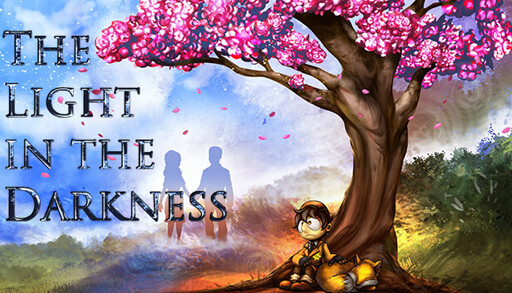
After I sent Rich Brownstein an email about Shoah software, I did a simple search online for ‘Holocaust video games’ and found out that I had completely overlooked this work.
The Light in the Darkness is the first (published) adventure game about the Shoah. Specifically, you play as a (petit bourgeois) Jewish family, as well as a couple of their friends, before and during the Axis occupation of France, and the story assigns you to a certain character depending on the section. This gives the audience a more personal connexion to the Shoah’s victims that would be harder to achieve in a book. Straightforward analyses of extermination campaigns certainly have their place, but tales like these are also needed to give the most serious students of history some emotional approximation of the events that took place.
Although you play as several different characters throughout this adventure, they handle identically, apart from their movement speed and several minigames. The minigames are all easy: there is the French equivalent to Simon says, there is a portion where you have to assemble a toy fox, a Tetris-like puzzle where you have to fit numerous crates into a lorry, and a portion where you have to sow a Judenstern onto an outfit. If you screw up, you can simply hit the restart button without any penalty. Although the designers encourage you to try their game with a controller, you can easily finish it with only a keyboard. If you enjoyed Grim Fandango or Escape from Monkey Island, this should not feel weird at all. The only thing that annoyed me was the want of dialogue controls: sometimes you can speed through dialog at your leisure, but other times you have to wait patiently, and there was one occasion where it went by too fast for me to finish reading.
As far as adventure games go, The Light in the Darkness is ridiculously straightforward: most of the time you are figuratively walking a one-way street. Unlike in an ordinary adventure game, you’ll hardly ever carry more than a single item at once, which would have made an inventory moot. Invisible walls are abundant, and opportunities to explore the world as sparse. Most of the NPCs with whom you can interact are story-critical; you can walk up to other NPCs, but most of them are speechless. Most of the doors cannot be opened either. Even the handful of dialogue options have no effect on the outcome; the makers intentionally released this game without a ‘good’ ending, since the Shoah’s survivors were, indeed, the exception to the rule.
As an educational tool, this is good: it covers the little-known Évian Conference, Ford’s antisemitism, the distribution of The Protocols of the Elders of Zion, and we see how the discrimination against France’s Jews evolved. (I have to admit that I was also unaware of Le Juif et la France until playing this.) It becomes especially depressing at the end where we read about how these characters could have lived had the Shoah never occurred. On the other hand, many of these lessons feel basic: we do not learn about how the Shoah manifested in other countries, and the authors never explain why the upper classes committed it, although we do get a clue at one point when the occupiers transfer the family’s microbusiness to a gentile.
Regarding the sound, there is not much to say: voice acting is almost nonexistent aside from one cutscene (wherein we can hear incomprehensible shouting), and the handful of sound effects include mundane noises like footsteps and knocking. Nothing fancy. The soundtrack consists of some French classical music, and there are a couple of moments when it adds to the tension or tragedy of the scenes, but ultimately it is nothing to write home about.
The graphics are The Light in the Darkness’s least appealing feature: the characters are all cel-shaded, Pixaresque cartoons with bulging eyes, which is bafflingly ill-fitting for the serious subject matter. The animations are mostly fine, but errors are sometimes noticeable, too, like Bluma’s eyebrows in one cutscene and objects that do not align properly with the characters’ movements, one particularly embarrassing example being a cup that floats underneath Bernard’s hand in the ending. The environments themselves look good, but misaligned textures are sometimes noticeable, especially in the apartment, and I saw a couple of texture errors, like the background in the transit camp. Finally, the dialog needed a proofreader: while many of the mistakes are limited to spacing, capitalisation and punctuation errors, there was one glaring issue where Jakob vaguely told Moses ‘I wish I would have done the same. Dragging my poor wife across France like some <’
Overall, though, I liked The Light in the Darkness. It is a bold but tasteful experiment that lets players experience Axis antisemitism from the perspective of its French victims. Being easy, gratis, and taking only 1.5 hours to finish, it is very accessible for any history student. That being said, it really does feel more like an experiment than an ordinary adventure game, because after you finish the story, there is not much reason to replay it unless you want to read it in the other language options. This is going to be something remembered more for its historical importance than its actual content, but seeing as how the designers are working on another Shoah adventure game titled Tears of Libya, this was a fine first step for the genre.