Germany was (and is) a parliamentary system. Hitler was the leader of the Nazi party, and the Nazis were elected to a plurality of the seats in the Reichstag.
The standard practice at the time was that the leader of the plurality party got to be Chancellor. To not have done so would have been weird and undemocratic.
To add to the other comment, it was also “weird and undemocratic” to grant the title of Chancellor to a dude who literally tried an undemocratic coup already and whose ideology was almost explicitly about dismantling democracy.
We can’t afford reverence to unspoken practices or customs or “good-faith” when dealing with fascists. Fascists are not dealing in good faith, they will use the system of laws and customs you created to get into power, cement themselves there by destroying parts of the system which oppose them, and finally get to enriching themselves as much as possible while sowing death and destruction and bigotry everywhere.
There were strategic mistakes made by the communists which indirectly helped hitler to power (the same kind was ironically made by dems in 2010s). But it was Hindenburg who turned hitler from a wannabe dictator into an actual dictator in charge of a country.
Hindenburg, the 230 duly elected Nazis (with there 13 million voters), and the Nazi party apparatus that made Hitler leader.
If you pull off a political miracle, you might be able to keep a 37℅ plurality (with significant electoral momentum) out of power for a cycle; maybe 2. But a democracy cannot keep such a popular movement out of power indefinitely.
The time to keep the Nazis out of power was the 1932 election. Any move after that is just a Hail Mary gambit
It was still a choice made by hindenburg, even within the confines of the “democratic” system. He had the power to not buckle to nazism. He could, by law and by custom, create a coalition government with Centre, SPD and KPD (who together had more support than NSDAP) and yet he didn’t, because he was part of the capitalist class and thought nazism would work out better for his class than socialism. It were not the voters who chose hitler, it was a bourgeois “lesser-evil” candidate.
The standard practice at the time was that the leader of the plurality party got to be Chancellor. To not have done so would have been weird and undemocratic.
That’s not remotely true and not how any parliamentary system works lmao.
Say two parties get 30% of the vote and a third gets 40%. The two parties don’t like the third one so they form a coalition with each other instead. That coalition is who 60% of the vote went to. They pick a chancellor who is amenable to both parties in the coalition. How on earth is that “undemocratic?”
The “standard practice” of the party with a plurality getting the position of chancellor was simply because the party with a plurality had always been part of the governing coalition.


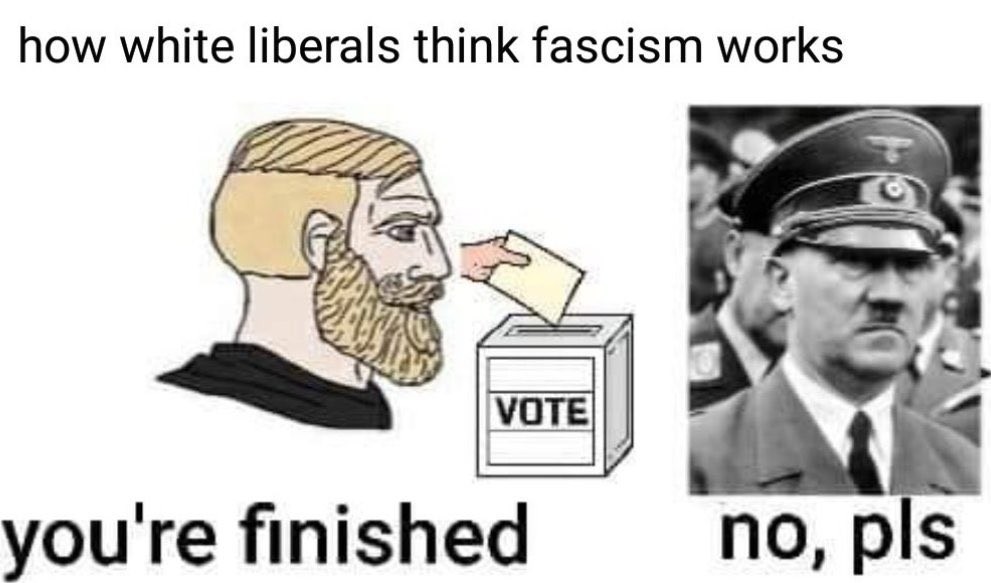
Germany was (and is) a parliamentary system. Hitler was the leader of the Nazi party, and the Nazis were elected to a plurality of the seats in the Reichstag.
The standard practice at the time was that the leader of the plurality party got to be Chancellor. To not have done so would have been weird and undemocratic.
To add to the other comment, it was also “weird and undemocratic” to grant the title of Chancellor to a dude who literally tried an undemocratic coup already and whose ideology was almost explicitly about dismantling democracy.
We can’t afford reverence to unspoken practices or customs or “good-faith” when dealing with fascists. Fascists are not dealing in good faith, they will use the system of laws and customs you created to get into power, cement themselves there by destroying parts of the system which oppose them, and finally get to enriching themselves as much as possible while sowing death and destruction and bigotry everywhere.
There were strategic mistakes made by the communists which indirectly helped hitler to power (the same kind was ironically made by dems in 2010s). But it was Hindenburg who turned hitler from a wannabe dictator into an actual dictator in charge of a country.
Hindenburg, the 230 duly elected Nazis (with there 13 million voters), and the Nazi party apparatus that made Hitler leader.
If you pull off a political miracle, you might be able to keep a 37℅ plurality (with significant electoral momentum) out of power for a cycle; maybe 2. But a democracy cannot keep such a popular movement out of power indefinitely.
The time to keep the Nazis out of power was the 1932 election. Any move after that is just a Hail Mary gambit
It was still a choice made by hindenburg, even within the confines of the “democratic” system. He had the power to not buckle to nazism. He could, by law and by custom, create a coalition government with Centre, SPD and KPD (who together had more support than NSDAP) and yet he didn’t, because he was part of the capitalist class and thought nazism would work out better for his class than socialism. It were not the voters who chose hitler, it was a bourgeois “lesser-evil” candidate.
That’s not remotely true and not how any parliamentary system works lmao.
Say two parties get 30% of the vote and a third gets 40%. The two parties don’t like the third one so they form a coalition with each other instead. That coalition is who 60% of the vote went to. They pick a chancellor who is amenable to both parties in the coalition. How on earth is that “undemocratic?”
The “standard practice” of the party with a plurality getting the position of chancellor was simply because the party with a plurality had always been part of the governing coalition.