

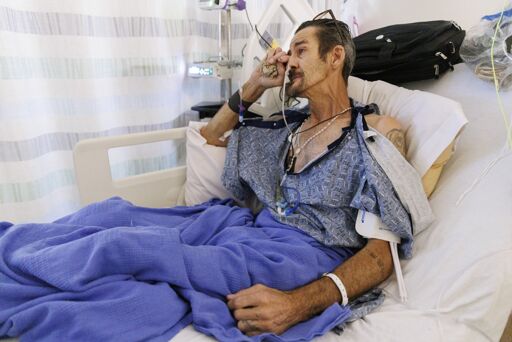
Over the 10 months Rodrigo spent in an ICE detention center east of Bakersfield, he asked repeatedly to see an oncologist about the tumor that was growing to the size of a lemon in his neck, pressing against his throat and making it difficult to speak or swallow.
The 58-year-old Los Angeles construction worker had survived throat cancer once, enduring 36 sessions of chemotherapy in 2022 before going into remission. When he was detained by ICE last September, he said, he’d been awaiting an appointment to see his oncologist about a small new lump he’d noticed.
In January, medical staff at the detention center requested that Rodrigo be evaluated by an outside oncologist, medical records reviewed by the Chronicle show. But for months ICE refused to approve the request while also trying to deport him.
Rodrigo, a green-card holder who had lived in the U.S. for 52 years, told the Chronicle in July during a phone interview from California City Detention Facility: “They’re not giving me any hope of surviving.”
Immigrants detained by ICE have long reported deficiencies in medical care, with sometimes fatal consequences. But the crisis has intensified since last October, according to former agency staffers and official records, after the Department of Veterans Affairs abruptly severed a long-held agreement with ICE to process medical claims from third-party specialists who provide care unavailable at detention facilities.
As the Trump administration detains record numbers of immigrants and ICE’s budget swells to $104 billion in the current fiscal year, the payment breakdown and other systemic problems have worsened medical neglect in ICE facilities, the Chronicle found, putting people at risk of severe disability, permanent injury or death.
ICE has not paid any of its providers for detainees’ care since Oct. 3, 2025, according to agency regulatory filings and the ICE website. In an internal directive issued shortly after, obtained by the Chronicle and not previously reported, ICE declared “emergency operations,” sharply limiting offsite medical care and access to medication.
Hospitals and ambulance services told the Chronicle they are owed millions of dollars, while many detainees have had appointments for lifesaving medical care delayed or canceled. Medical providers say they have continued to provide care out of moral obligation, although some observers worry that fear of nonpayment could deter them from offering services to detainees.
ICE’s 2025 national detention standards require facilities to provide “medically necessary and appropriate medical, dental and mental healthcare and pharmaceutical services at no cost to the detainee.” Yet according to medical invoices and legal filings reviewed, detainees have been directly charged thousands of dollars for medication and care they received while in ICE custody.
…
Waiting months to diagnose and institute a treatment plan for someone with advanced laryngeal cancer was “not even close” to the medical standard of care, said Dr. David Baron, a physician in Cambridge, Mass., who reviewed Rodrigo’s case. “It is just a heartless thing to do,” he said. Without treatment, Baron said, the cancer would likely grow and spread to other parts of Rodrigo’s body, leading to complications, including obstructions to his airway, which could cause him to choke, have pneumonia or eventually, to die.
Rodrigo was arrested by ICE last year at a check-in after being stopped at an airport on the basis of a decade-old criminal conviction. After he first spoke to the Chronicle, the conviction was vacated. He was ordered released from detention in early August after a judge ruled his ICE arrest was illegal.
Within days, he was hospitalized for a brain aneurysm caused by a blood clot in his growing tumor, he told the Chronicle. He hopes to see an oncologist, but fears the tumor, now pressed against his vocal cords and the main artery in his neck, may not be operable.
…
At the Amica Center for Immigrant Rights, an immigration legal aid nonprofit in Washington, D.C., staff members have taken to calling it the “death policy.” Adina Applebaum, a spokesperson, said, “ICE’s denial of medical care is a deliberate policy choice, not an accident.”
…
The amount ICE owes its medical providers is unknown, but six providers who spoke to the Chronicle said that, as of July, they were waiting on nearly $5.6 million for services dating back to last October, with some awaiting payment for hundreds of detainee care visits.
From October through August, ICE accumulated $3 million in unpaid bills to Scripps Health, a San Diego-based nonprofit health system, spokesperson Janice Collins said.
In rural Pennsylvania’s Moshannon Valley, ICE owes a nonprofit EMS agency roughly $197,000 — 13% of its annual revenue — for trips to a detention center between October and the end of July. The nonprofit’s EMS chief, Fredrick Ferguson, said his agency has continued to respond to calls because it has a “moral and ethical obligation” to do so.
In Bexar County, Texas, University Health had more than 1,000 claims as of June for services provided to detainees since last October, totaling over $2.2 million in unpaid bills, hospital spokesperson Elizabeth Allen said. Farther south, along the border in Cameron County, the nonprofit Los Fresnos Ambulance Services Co. has not received payment for ICE transports made since last October and is owed $45,000, Emergency Services Chief Gene Daniels told the Chronicle.
…
In the absence of reimbursements, detainees in facilities across the country increasingly appear to have been directly charged for medical care. Among them was a Sacramento man detained at California City who was later pursued by debt collectors for a $634 blood test he received while in custody.
After complaining for months of bloody stool and coughing up blood, the South Asian immigrant seeking political asylum passed out in his cell in October. Detention staff took him to an emergency room in a van, handcuffed.
The ACLU sent letters to ICE in May 2025 and May 2026 exhorting the agency to stop charging detainees for medications at FCI Leavenworth in Kansas and North Lake Processing Center in Michigan.
Under constitutional due process, the federal government must provide and pay for medical care to those in its custody, said UC Berkeley School of Law Dean Erwin Chemerinsky.
“People in ICE detention can’t go and get their own doctors or medical care,” he said, calling the billing of detainees “just outrageous.”