

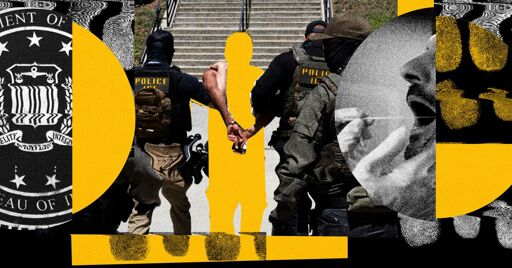
On March 13, 2025, Hugo Moreno-Mendez arrived at the McLennan County Probation Department in Waco, Texas, expecting a routine probation check-in. Instead, Immigration and Customs Enforcement officers were waiting to arrest him.
According to a criminal complaint reviewed by WIRED, officers drove Moreno-Mendez to a nearby ICE field office. There, one deportation officer after another approached him with the same demand.
Open your mouth.
One officer tried to take his fingerprints and swab the inside of his cheek for DNA. He refused. Then another tried. Then a third. Each time, Moreno-Mendez refused.
Four days later, Moreno-Mendez was charged with failing to register as a noncitizen and refusing to provide DNA while in federal custody—the latter a misdemeanor that, as of 2021, ICE itself said it was unaware had ever been accepted for prosecution.
Moreno-Mendez took both counts to trial. On August 18, 2025, a magistrate judge in Waco found him guilty of each and sentenced him to time served.
Moreno-Mendez’s case is part of a sweeping expansion of DNA collection from people held for civil immigration violations—a federal campaign that, backed by the threat of prosecution, funnels the genetic profiles of nearly everyone in ICE custody into an FBI database built for criminal investigations. New research from Georgetown Law’s Center on Privacy and Technology estimates that the Department of Homeland Security has become the largest single source of new genetic profiles in the nation’s criminal DNA system, with ICE alone potentially adding as many as roughly 920,000 profiles in 2025.
The vast majority of people in ICE custody have no criminal conviction, and residing in the US undocumented is typically a civil, not criminal, offense. Yet once the DNA profiles of detained people enter the FBI’s Combined DNA Index System, or CODIS, law enforcement agencies across the country can compare them against evidence from unsolved crimes—and against crime-scene DNA collected years or even decades from now. The physical sample, which holds a person’s entire genome, sits in a federal laboratory indefinitely.
The expansion of DNA collection has extended to families held in immigration detention, sparked lawsuits over the collection of DNA from protesters and others who allege they should never have been subjected to the program, and drawn congressional scrutiny after lawmakers learned that children were being swabbed at a family detention center in Dilley, Texas.
“None of the families at Dilley have been convicted of a crime,” US representatives Joaquin Castro, Greg Stanton, and Nanette Barragán said in a joint statement to WIRED. “They do not belong in a database meant for violent criminals, especially children.”
…
The change tracks a broader shift. According to Transactional Records Access Clearinghouse data cited by Georgetown, CBP once accounted for the majority of immigration detentions. ICE now accounts for roughly 85 percent, CBP for 15. As of July 11 of this year, ICE was holding 65,765 people, up from 60,311 in early April, while arrests climbed toward 1,500 a day, according to Austin Kocher, a research assistant professor at Syracuse University. The largest single group in detention had no criminal history at all.
…
During a May 2026 inspection of the Dilley Immigration Processing Center in South Texas, members of Congress tell WIRED, ICE officials told them the agency had been collecting DNA from detained families for the previous three months. Immigration officials offered conflicting explanations for why the samples were being taken, where they were sent, and how long they would be retained, according to the lawmakers, who later demanded answers from DHS.
In correspondence sent last month and obtained by WIRED, DHS told US representatives Joaquin Castro, Greg Stanton, and Nanette Barragán that ICE may collect DNA from children as young as 14. The department also confirmed that samples collected under the program are sent to the FBI for analysis and entry into CODIS.
Federal immigration agencies have not always followed even that age limit. Newly released CBP records analyzed by Georgetown and independently reviewed by WIRED identify 492 children under 14 whose DNA the agency sent to the FBI between January 2025 and January 2026—including 33 7-year-olds, 32 6-year-olds, and 21 5-year-olds.
If you don’t care about the law, a lot is possible.
