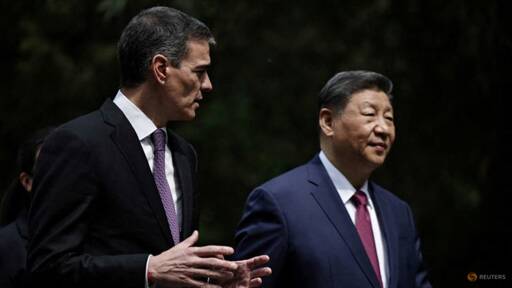
Pedro Sanchez also called China's trade imbalance with the European Union "unsustainable" and called on Beijing to open its market to European imports.
Just look at a map of absolute poverty and armed conflicts in the world today. They pretty much overlap. Other countries like Brazil or India also managed some huge decreases in absolute poverty in the same time.
The share of China’s national income earned by the top 10% of the population has increased from 27% in 1978 to 41% in 2015, nearing the U.S.’s 45% and surpassing France’s 32%.
Similarly, the wealth share of the top 10% of the population reached 67%, close to the U.S.’s 72% and higher than France’s 50%.
Vamsi Vakulabharanam, Associate Professor of Economics at University of Massachusetts Amherst and a dedicated expert for research of inequality, explained in an interview last year:
In China, the economic reforms initiated after 1978 tended to reduce inequality until the mid-1980s. This is because the initial reforms were focused on agriculture and in creating special economic zones (e.g., Shenzhen) that led to rapid economic growth in sectors and regions that had witnessed slower growth in the previous three decades. At the same time, the rural non-agricultural sector (e.g., Township and Village Enterprises) grew rapidly and contributed significantly to a spurt in exports from China during the 1980s. After 1985, when the coastal development strategy was initiated, within-country inequality began to rise in China. This increase in inequality had two major sources. The coastal region (and river delta regions) tended to grow faster compared to the central and western regions, thereby creating a trend of rising regional inequality. At the same time, as the urban sector started growing faster than its rural counterpart, there was a rapid growth in the gap between urban and rural areas. These two processes started by the early 1990s to push up the inequality rates up in China.
To provide a more recent picture, China has more dollar billionaires (1,110, up by 287 year-on-year) than the US (1,000, up 130 year-on-year), according to the 2026 Hurun rich list.
The rise in nequality in China has also many other reasons that are widely unknown in the Western hemisphere as they are rooted in a very unique Chinese social and societal system that comes with a lot of disadvantages for those affected. For example, there are more than 250 internal migrant in China with no hukou in urban areas. Simply speaking, this means they are allowed to conduct certain work in urban areas, but are registered in the rural areas where they come from. Without a hukou, however, people often face difficulties accessing essential public services such as education, healthcare, and social welfare, as these are typically tied to one’s registered location.
As Dr. Vakulabharanam said in the linked interview in this comment above:
This sort of a gap [between rich and poor] could not have arisen if the Chinese state was committed to egalitarianism, even with some leeway for a dictum like some inequality is acceptable if the overall economy achieves significant growth. The Chinese Communist Party must rediscover egalitarianism in the deeply unequal society that China has turned into after the market reforms of 1978.
You hate china because you only post about China rel human right abuses while ignoring countries will worse track records like the uae, israel and the united states. How you critisize spain shows that is it all about opposing any form of socialism
Look at the development in the country, bro, inequality in China is on the rise and is reaching US levels, bro, while democracies’ inequality is much lower.
And systems like hukou exclude ~250 million Chinese - roughly a quarter of the adult population - from essential services like health care.


deleted by creator
1990 there were nearly three times as many people living in absolute poverty in China then in Sub Saharan Africa.
deleted by creator
Just look at a map of absolute poverty and armed conflicts in the world today. They pretty much overlap. Other countries like Brazil or India also managed some huge decreases in absolute poverty in the same time.
deleted by creator
And China has a fascist one. It clearly is not that much down to the system.
deleted by creator
Since 1978, China has transformed from a poor, relatively equal society to a leading global economy with levels of inequality surpassing much of Europe and resembling the U.S:
Vamsi Vakulabharanam, Associate Professor of Economics at University of Massachusetts Amherst and a dedicated expert for research of inequality, explained in an interview last year:
To provide a more recent picture, China has more dollar billionaires (1,110, up by 287 year-on-year) than the US (1,000, up 130 year-on-year), according to the 2026 Hurun rich list.
The rise in nequality in China has also many other reasons that are widely unknown in the Western hemisphere as they are rooted in a very unique Chinese social and societal system that comes with a lot of disadvantages for those affected. For example, there are more than 250 internal migrant in China with no hukou in urban areas. Simply speaking, this means they are allowed to conduct certain work in urban areas, but are registered in the rural areas where they come from. Without a hukou, however, people often face difficulties accessing essential public services such as education, healthcare, and social welfare, as these are typically tied to one’s registered location.
As Dr. Vakulabharanam said in the linked interview in this comment above:
@antisoumerde@quokk.au
@mrdown@lemmy.world
As an addition particularly to @mrdown: I don’t hate China. Your accusation in this thread is fabricated and wrong.
You hate china because you only post about China rel human right abuses while ignoring countries will worse track records like the uae, israel and the united states. How you critisize spain shows that is it all about opposing any form of socialism
No, you are wrong. Read my comments.
deleted by creator
Look at the development in the country, bro, inequality in China is on the rise and is reaching US levels, bro, while democracies’ inequality is much lower.
And systems like hukou exclude ~250 million Chinese - roughly a quarter of the adult population - from essential services like health care.
This has nothing to do with socialism, bro.
deleted by creator