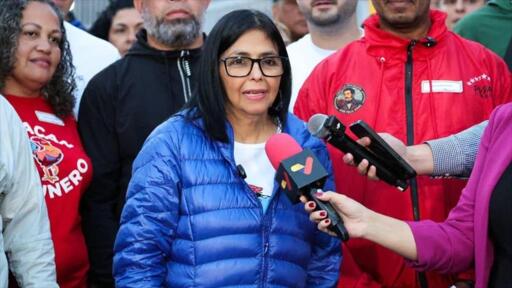
Venezuela’s interim president defended her country’s independence to have relations with other countries such as China, Russia, Cuba, and Iran.
“Venezuela has the right to relations with China, with Russia, with Cuba, with Iran, with all the peoples of the world, and with the U.S. as well,” Delcy Rodríguez emphasized on Thursday during her annual address to the nation, following the kidnapping of Venezuelan President Nicolás Maduro and his wife, Cilia Flores, by the U.S.
He also noted that his country is currently “in the midst of aggression and a fierce threat,” and that his government, under Maduro’s guidance, is “shaping what energy cooperation should be, based on decency, dignity, and independence.”
After recalling the US military aggression against Venezuela that left more than 100 victims, he stated that “the constraints on internal politics and the constraints that seek to dominate our foreign policy, will definitively dissipate.”
Rodríguez says that if she has to go to Washington she will go “standing tall”, but “not dragged along”
Elsewhere in her speech, Rodríguez stated that if she had to go to Washington, she would go “standing” and “walking,” but not “dragging herself along,” and asserted that she was not afraid of a diplomatic confrontation with the United States.
“It’s not that the acting president is afraid because she’s being threatened. No. All of Venezuela is under threat (…). If one day I, as acting president, have to go to Washington, I will do so standing tall, walking, not crawling. I will do it with the tricolor flag,” she added.
The president also accused the U.S. of limiting the South American country’s ability to sell its oil industry products abroad after the “naval blockade” imposed on oil tankers linked to Venezuela.
Regarding the naval blockade against Venezuela launched last December, Rodríguez assured that there is a plan for this new year “in free trade relations with the world, so that it can sell the products of its energy industry.”
On January 3, the U.S. bombed Caracas and several areas of the states of Miranda, Aragua and La Guaira, leaving at least 100 dead , in a military aggression that ended with the kidnapping of Maduro and his wife.
Following this aggression, US President Donald Trump declared that he would assume control of Venezuela; meanwhile, US Secretary of War Pete Hegseth argued that the military operation would allow Washington access to the “additional wealth and resources” of the Bolivarian country.
For its part, Caracas had also denounced that Washington carried out the “very serious military aggression” with the objective of seizing Venezuela’s strategic resources, particularly its oil and minerals.
Sounds like a bit of an awkward “what now?” situation for the US. They took out the person they played up as being a dictator running everything, congratulations, except ,surprise, the country wasn’t actually a one man dictatorship and nothing has changed.
I don’t know what Trump himself expected, but I do think the neocons in his cabinet legitimately bought into their own propaganda about Maduro’s unpopularity and infighting with the Chavistas, and were genuinely surprised at the smooth power transition.
To be fair, it seems like the corporate side of Trump’s base doesn’t really care either way as long as they can get the deals they want, so it isn’t a huge blunder or anything of that sort, but it does mean all the anti-Maduro propaganda is wasted because he’s no longer in charge.