

- cross-posted to:
- worldnews@lemmy.ml
- cross-posted to:
- worldnews@lemmy.ml
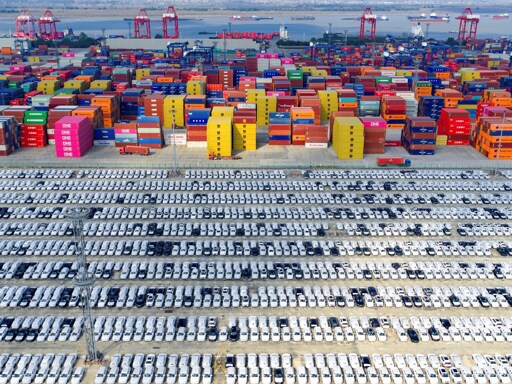
China’s annual trade surplus in goods has topped $1 trillion for the first time, with plunging exports to the United States amid a tariff war more than compensated for by shipments to other markets, new data shows.
Figures released by China’s General Administration of Customs on Monday showed the trade surplus for the first 11 months of the year hit $1.08 trillion in November, as exports climbed 5.9 percent year-on-year that month, reversing a 1.1 percent decline the month prior.
The leap came despite a continued slump in exports to the US, which fell 28.6 percent to $33.8bn last month, the data showed.
Beijing and Washington have been locked in a bitter trade war involving hefty tariffs during the second administration of US President Donald Trump, forcing Chinese exporters to pivot to other markets – although the leaders of the world’s two largest economies agreed to pause the hostilities during a meeting in South Korea in October
You must log in or # to comment.
I wrote this comment in another thread, and it fits well also here.
The article says,
Beijing and Washington have been locked in a bitter trade war involving hefty tariffs during the second administration of US President Donald Trump, forcing Chinese exporters to pivot to other markets
Although this is true and it has certainly intensified the situation for China, the country had begun its trade diversion long before Trump’s tariff conundrum. And the reason was not abroad but at home: it was China’s weak domestic consumption as per a recent study by the European Central Bank (ECB).
It has found that the rise in China’s exports to the EU predates the latest tensions and coincides instead with the onset of weakness in demand at home in China, the ECB says.
In the fourth quarter of 2024 the average monthly value of domestic sales was around four times higher than total exports and over 28 times larger than exports to the United States. This suggests the pool of goods that could be redirected to the EU is much broader than trade data alone would suggest. Redirecting even a small share of domestic sales abroad could boost overall exports – including to the EU – more than a sizeable diversion of exports from the United States.
The ECB argues that the start of rising exports and slowing imports dates back to 2021, when China’s crisis in its domestic real estate market - typically an import-sensitive sector - sharply curtailed household demand.
At the same time, state-imposed manufacturing investment created overcapacity in industries that would otherwise face market-driven constraints, which eventually resulted in fierce price wars in Chinese home markets forcing companies to seek relief in exports.
The ECB writes:
This has eroded profit margins and discouraged spending in a deflationary environment with significant labour slack – prompting firms to redirect sales toward foreign markets.This shift reflects the “vent-for-surplus” theory of international trade, which posits that a demand-driven decline in domestic sales generates excess capacity that can be redirected abroad. The mechanism assumes fixed investment in the short term, which is particularly relevant in China, where investment is often guided by central planning. To expand abroad, firms must gain competitiveness in foreign markets. They typically do so by reducing short-run marginal costs and prices, or by accepting narrower profit margins, and in some cases even losses. - [Emphasis mine.]