Unruffled [they/them]

“In every State, the government is nothing but a permanent conspiracy on the part of the minority against the majority, which it enslaves and fleeces.”

  • Mikhail Bakunin

Queer/trans gender abolitionist | anarchist | piracy enthusiast

aspe:keyoxide.org:LSZT4AL3BUPMJZGHIJAVZAJLHY

  • 0 Posts
  • 26 Comments
Joined 1 year ago
cake
Cake day: August 18th, 2025

help-circle


  • I think it’s maybe a sample of a sample from this track?

    Sighter - Existence (Wanted Remix) lyrics

    The righteous shall dwell in the land forever
    The meek, the gentle, the patient, the kind
    Shall finally be the ones that inherit this troubled planet
    So learn to be patient and gentle with one another
    That’s the most important attribute of God (God [?x])

    That’s the most important attribute of God

    The righteous shall dwell in the land forever
    The meek, the gentle, the patient, the kind
    Shall finally be the ones that inherit this troubled planet
    So learn to be patient and gentle with one another
    That’s the most important attribute of God (God [5x])

    The meek, the gentle, the patient, the kind

    https://youtu.be/cMYgbzUwGp0


  • I 100% agree modlog abuse is something that needs to be addressed. But I’d much prefer for admins and users to be consulted about such changes, because Rimu’s currently “solution” undermines trust, breaks transparency, and breaks normal federation. That’s why one gung ho developer doing whatever he pleases can be a liability on occasion instead of an asset.

    I’d like to suggest an alternative approach that could work for both Lemmy and Piefed, while maintaining normal federation.

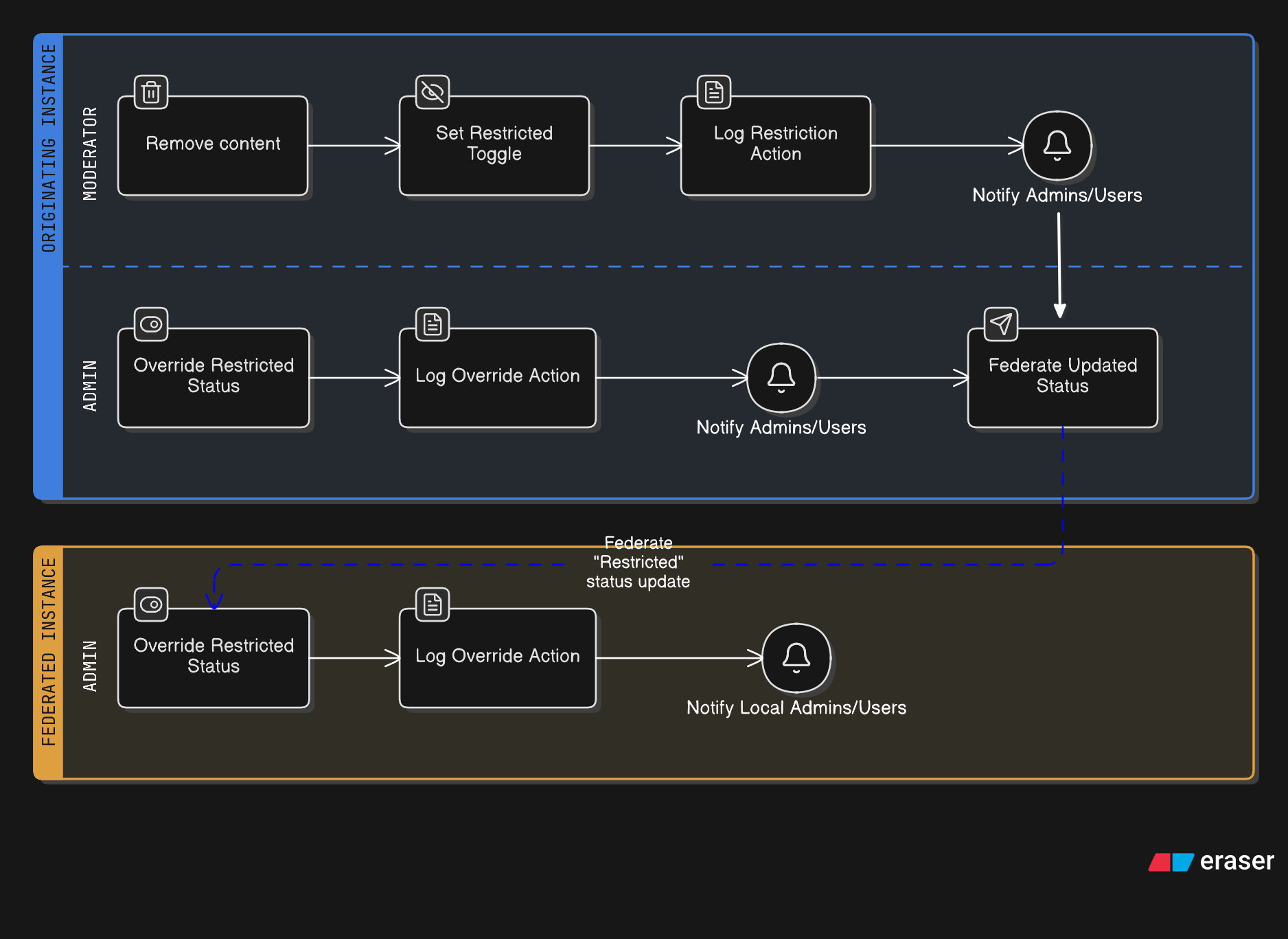
    Proposed process for “Restricting” visibility of a modlog entry:

    Type 1

    • Person: The originating instance admin/moderator
    • Action: During admin or mod comment/post removal, enable a toggle to set the modlog entry as “Restricted”

    Type 2

    • Person: The originating instance admin only
    • Action: If admin user, enable on/off toggle for “Restricted” flag for a modlog entry which will override any previously set flag. The updated flag status would then federate out to all federated instances.

    Type 3

    • Person: federated instance admins only
    • Action: If admin user, enable on/off toggle for “Restricted” flag for a modlog entry which will override any previously set flag. The updated flag status would only apply to the federated instance and would not federate out.

    Explanation

    For type 1 scenarios, once a mod or admin at the originating instance performs a comment or post removal, they would have the option to restrict public access to the modlog entry. There should be a clear warning, “This option should be used very sparingly, and only for defamatory comments, CSAM, or personally identified information.” The default should be for “restricted” status to be off, as is the case currently. This alone would deal with a great many of these issues.

    For type 2 scenarios, instance admins would be able to override the status of the “restricted” toggle for all modlog entries. That will enable admins to override the status set by mods within their own instance. If set by an admin of the originating instance, then then updated “restricted” status should federate to all federated instances. This will allow us to deal with the occasions where internal mod actions need to be overruled.

    For type 3 scenarios, this allows for any instance to have the freedom to override the federated status of the modlog entry at the admin’s discretion. That allows for whistleblowing in event an instance is abusing the “Restricted” flag, and maintains the independence of each instance to make that choice for themselves. Of course, doing so may invite a defederation or other sanctions if other admins disagreed with changing the “restricted” status. So I think this is a reasonable checks-and-balances approach, which provides necessary info to federated instance admins, so we can all trust that the function is not being abused.

    image

    What I would really like is some serious engagement from the developers of PieFed and Lemmy on this issue, since it is clearly something that we would all like to see resolved as a priority item. Currently I believe the software platform itself is likely non-compliant with GDPR requests due to the current modlog implementation.

    Rimu’s “solution” really fixes nothing because there is a simple and obvious workaround. A user creates an account on piefed.social or another “trusted” instance, creates a community on that instance, then weaponizes the modlog from within the trusted circle.

    And in addition to not addressing the fundamental issue, the “solution” also introduces the concept of two-tiers of federation. The “trusted” instances get “first-class” federation, but anyone the admin feels are not trusted gets assigned a “second-class” version of federation, including much less visibility. That is simply shadow banning under another name, and it feels like a way too Reddit-like for comfort, imo. The user should be in full control of their own feed preferences, not the instance admin.

    I also think that by default, all moderation actions and content should continue to be public as a core principle. A removal from the modlog should be the exception, not an instance-wide rule that is set at the whim of one person.

    Does this not seem like a more reasonable and sane approach to take? Rimu’s approach appears to have been unilaterally decided, poorly thought out, and quite honestly just makes me want to step away from the PieFed project altogether. Why was community feedback not sought before this change was implemented? And why was Rimu’s particular implementation decided to be the best path forward for PieFed? I’d like to understand whether other developers and admins actually using PieFed are actually being consulted about these changes in advance, or are these ultimately unilateral decisions being made by one person with a short fuse?


  • Just a quick update. This is more complicated than it might seem at first glance. I spoke to a couple of other admins including Mr Kaplan from LW and apparently the only mechanism in Lemmy to federate out a removal of a modlog entry is for them to restore the comment, and then have the OP on anarchist.nexus delete the comment themselves.

    I have reached out to the person who posted that comment and asked them if they are willing to delete it. If not, then I think the only alternative would be to reach out to every single federated instance admin to purge the comment manually. And I don’t like your chances of reaching them all. This particular scenario has not been catered for yet in the software, unfortunately.

    So, I am just waiting to hear back from the user. If they agree to delete the comment, then I will contact Kr Kaplan again to have the comment restored, and it should then be deleted shortly after that by the OP.


  • I quite like this summary from https://www.skeptic.ca/Anarchism_Introduction.htm because it points out a few key differences.

    The basic tenet of anarchism is that hierarchical authority – be it state, church, patriarchy or economic elite – is not only unnecessary, but is inherently detrimental to the maximization of human potential. Anarchists generally believe that human beings are capable of managing their own affairs on the basis of creativity, cooperation, and mutual respect. It is believed that power is inherently corruptive, and that authorities are inevitably more concerned with self-perpetuation and increasing their own power than they are with doing what is best for their constituents. This is equally true in Totalitarian and Communist states as it is in Democracies. Anarchists generally maintain that ethics are a personal matter and by definition must be based on concern for others and the well being of society as a whole, rather than upon laws imposed by a secular or religious authority (including revered laws such as the U.S. Constitution). Not unlike existentialist philosophers such as Jean Paul Sartre, most anarchist philosophies hold that individuals are responsible for their own behavior, life goals and ultimate purposes in life. The anarchist needs no one to tell him what he ought to do and how to create a meaningful life. Paternalistic authorities foster a dehumanized mindset in which people expect elites to make decisions for them and meet their needs, rather than thinking and acting for themselves. When an authority arrogates to itself the right to overrule the most fundamental personal moral decisions, such as what is worth killing or dying for (as in military conscription or abortion), human freedom is immeasurably diminished.

    Anarchists acknowledge the connection between various forms of oppression – including sexism, racism, heterosexism, classism, and national chauvinism – and recognize the futility of focusing opposition on one form of injustice while others continue to exist. Anarchists believe that the means one uses to transform the world must be in accord with the ends that one hopes to achieve. While anarchists disagree about strategies and tactics, including the need for formal organizations and the use of violent action to overthrow existing oppressive institutions and injustice, most agree that the focus must not be on merely destroying the current order, but on fashioning new, more humane and more rational alternatives to take its place.

    While many anarchists value cooperation, communalism and collectivism, anarchists reject both the plutocracies of capitalist states based exclusively on greed and envy and the totalitarianism of the existing and recently fallen communist, or more accurately Marxist-Leninist, states. The rift between anarchists and Marxists developed as early as the 1870s as anarchists perceived that the Marxists were perpetuating authoritarianism under a different name. Marxist-leninists groups have traditionally emphasized the need for a vanguard party and the dictatorship of the proletariat, ideas which are fundamentally opposed to the anarchist focus on anti-authoritarianism and maximum individual freedom. Although orthodox Marxism predicts that the state will “wither away” with time, we have repeatedly seen in communist regimes a consolidation of state power and its attendant repression and insistence on conformity. The same oppressive authoritarianism has emerged in capitalist democracies.

    I just re-read your question btw, and realized I kind of answered the wrong question here, because the quotes focus on the differences in the means rather than in the end goal. But it’s still good context, because communism has so far never been able to move beyond the authoritarian stage, so you could reasonably argue that the actual end state of communism is an authoritarian state with a socialist economy, especially if they have to co-exist in competition and conflict with capitalist states. So the end goal of the state “withering away” is more or less impossible to achieve via communism while western hegemony exists.